
Introduction
So. You want to keep the feasts of our Creator in their proper season, eh? Or more specifically, you want to know when the 1st lunar month arrives, in order to keep Passover at the correct time? We have the same desire, my friend, so let’s figure it out together. Because apparently, this matter is quite important to the Father.
Exodus 12:1-2 — 1 And יהוה spoke to Mosheh and to Aharon in the land of Mitsrayim, saying, 2 “This month is the beginning of months for you, it is the first month of the year for you. (The Scriptures)
Think about this: the days of slavery were at an end, the Exodus was near at-hand, and things were about to get, well, biblical. But before our Creator released the final blows on the Egyptians, he explained the regulations of the Passover, including when it’s observed: “this month shall be unto you the beginning of months.” Nothing else was relevant until Moses understood which month came first. Unfortunately for us, this event was thousands of years ago; so today, it’s not entirely clear which month was “this month.”
Though thankfully, scripture has a way of filling in the blanks — if you know where to look.
I’m going to show you two different methods to finding the start of the lunar year, and how it can even be determined from six months in advance. I’m also going to explain how the Day of Atonement can help us confirm whether or not we’re in the correct month.
And believe me, we need all the confirmation we can get when it comes to the calendar; because honestly, there’s many who begin the lunar year too soon. I’m not judging or condemning; we’re all still learning. And besides, the ones celebrating Passover too soon are just eager to get the leaven out of their lives, and what’s wrong with that? But for you, it’s my sincere hope that by the end of this article you’ll be celebrating the feasts with joy and certainty, rather than worry and doubt.
Let’s get started.
Method #1: Starting At The Spring Equinox
The most straightforward answer is this…
The 1st new moon of the year comes in the spring, but not until the time of the spring equinox — at the earliest. Starting the lunar year any sooner than the March equinox can pull your feast schedule out-of-line by an entire month.
Imagine showing up to a dinner party a month too soon. I mean, being that guy or gal that shows up an hour early is bad enough, but a month. Sheesh. Let’s try not to do that.
So, if a new moon arrives before the spring equinox, that month cannot be used to start the lunar year. These months would be a 12th or a 13th lunar month, and not a 1st month. But, for all new moons at the equinox or later, they are to be the 1st new moon and the start of the lunar year. From here you can start keeping the biblical feasts in their proper time. Enjoy!
Easy right? That’s the simple answer. Follow this method, and you’ll be keeping the correct lunar months and feasts days almost every year.
— Wait. Did he just say almost every year?
Unfortunately, yes. Yes I did. And that’s because our modern-day astronomers and calendars don’t always align with (the perfection that is) the book of Enoch. As a result, the spring equinox dates on the Gregorian calendar and the Enoch calendar could vary by a day from year to year. So while the world may be observing the equinox on March 20th, it technically could have arrived the day prior — on March 19th.
Because of this occasional glitch in the matrix, the full answer is going to require a little more explanation.
Method #1.5: Starting At Day 179
Here’s the first thing we have to understand: the solar year begins at the fall equinox. That’s day 1 on the Enoch lunisolar calendar. (Check out “When Does The Biblical Year Begin?” for more on that topic.) This is the day when the sun casts a straight shadow from sunrise to sundown.
It looks something like this…
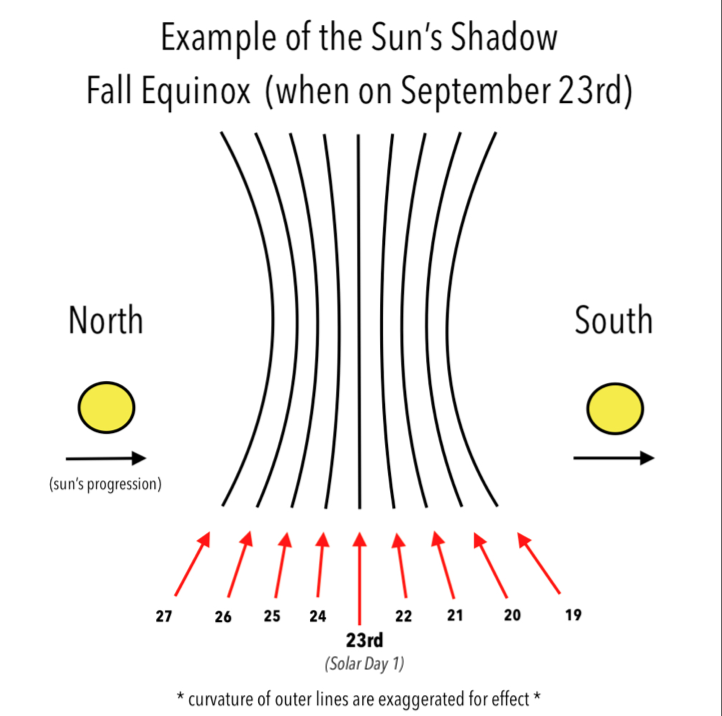
Before the fall equinox, the sun’s shadow bends southward, and after the fall equinox it bends northward. This occurs as the sun moves from the northern sky (hemisphere) to the southern.
Are we good so far?
After the sun makes its circuit to the winter solstice (in December), it then returns along the same path, before eventually reaching the spring equinox (in March). And since the straight shadow in the fall is the start of the solar year, the straight shadow in the spring is the start of the lunar year. Makes sense, right? The straight shadow is the dividing point of the year, and also the starting line for the sun and the moon.
Have you ever seen a race begin with a starting line that was curved or bent? That would be weird, wouldn’t it? And unfair, too. Well as it turns out, the luminaries are similar. When the line is straight, it’s time to run…
- Though there is a slight difference when the solar year approaches a leap year (366 days). Check out “How To Find The Equinox WITHOUT A Sundial” for more on that topic.
… This ‘starting line’ in March comes on solar day 179. This is when the sun moves between the southern and northern skies (hemispheres) — the reverse of day 1 in September. Then, solar day 180 is when the sun’s shadow bends northward for the first time.
Sometimes the spring equinox is recognized at the correct time, on day 179; but other times it’s on day 180.
Similar to this…
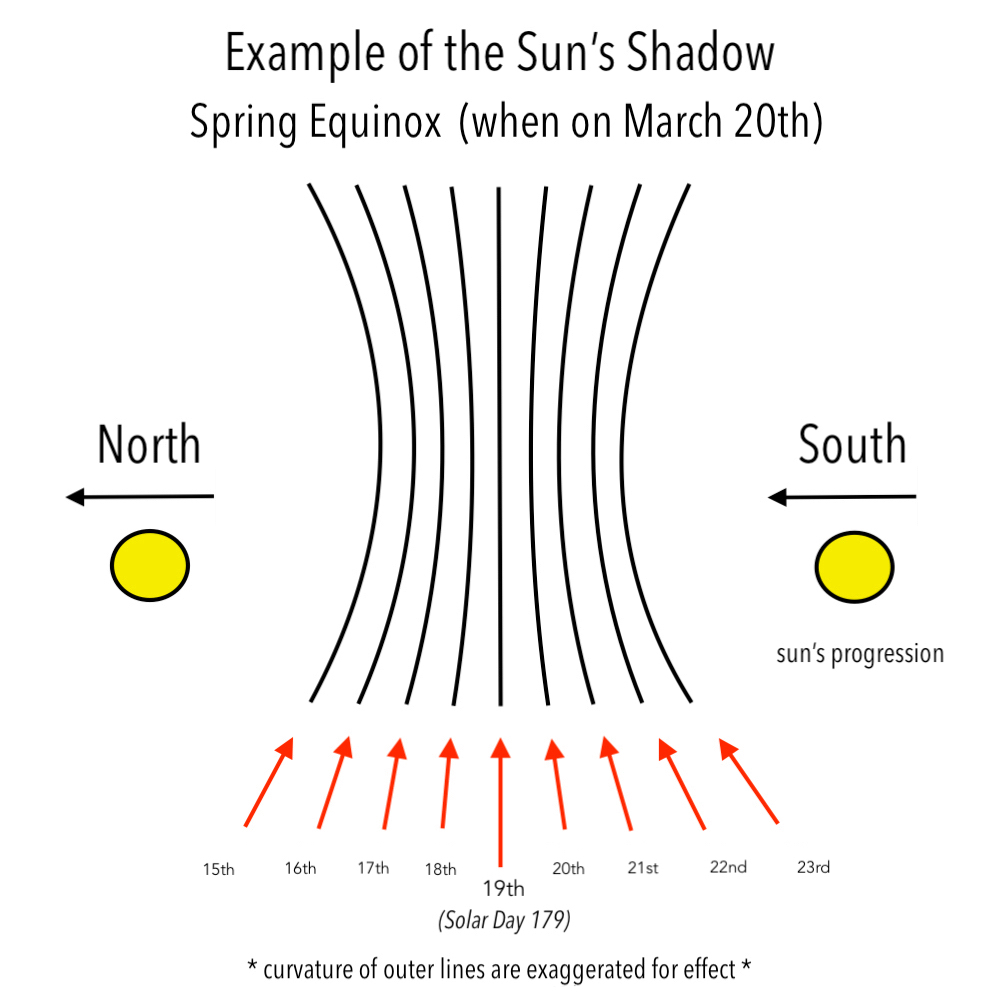
This variation could be due to leap years, and how the sun’s movement pushes back ever-so-slightly to compensate for an extra day. Because of this, the spring equinox isn’t recognized in quite the same manner.
This is why if we want to be perfect, we have to be aware of what solar day it is on the Enoch calendar, and not just what day it is on the Gregorian calendar. And we can do this best by using a sundial.
This video might help…
One more thing to keep in mind: the biblical day begins at sundown, not sunrise. So if the spring equinox were to arrive during the daytime hours of March 20th, then a new moon from the evening of March 19th would be an acceptable starting point, since that falls within the same biblical day. But any new moon prior to this would be a 12th or a 13th lunar month.
(If you want to learn more about when a biblical day begins, CLICK HERE.)
If any these details have begun to feel overwhelming, or are starting to make you fret about being off a day — take a deep breath, and relax. It’s going to be alright. Because honestly, it’s not as bad as it sounds.
Here’s why…
Only one time every 19 years does the 1st new moon come a day before the world recognizes the spring equinox, and only one other time does the lunar year begin on the equinox. Twice in a 19-year period. That’s it. (The nearest years are 2026 and 2037, in case you’re wondering.) Every other lunar year arrives after the equinox has passed.
So in most cases, it will be fairly easy to establish the 1st new moon; but now you understand the finer details that most people are unaware of. And when those borderline years do arrive, you’ll be ready. Perhaps you’ll even be ready to teach others. How great would that be?
This is only the first method. If you’re ready for Method #2, or “The Second Witness,” let’s keep going.
Method #2: Count To 7
The number ‘7’ seems to have a special place in our Creator’s heart. It appears again and again throughout scripture. Here’s just a few examples…
- He rested on the 7th day.
- A jubilee cycle is 7 x 7 years.
- The fall feasts begin in the 7th month.
Would it be surprising, then, that ‘7’ appears again when it comes to counting the lunar months? Now granted, it’s not as apparent as the other instances I just mentioned. I actually stumbled upon it by accident, myself. But once you spot this immaculate pattern of ‘7,’ you’ll see just how easy it is to follow; and it’ll help you start the lunar year on time — every time.
Here’s how it works.
Once the solar year begins with the fall equinox in September, the 7th lunar month on or after that date will be the 1st lunar month of the next year. So for example, if the new moon of the 7th month is on day 3 of the solar year (as in 2025), then that lunar year will have 12 months in total; and the 1st month of the next lunar year will also be the 7th new moon after the fall equinox.
Does that make sense?
This would also be the case if the new moon of the 7th month is on day 1 of the solar year (as in 2036). Which is why I said “on or after” the fall equinox.
Here’s a breakdown…
When the 7th new moon arrives on or after the start of the solar year, then…
- The 7th new moon is the 1st month after the fall equinox.
- The 8th new moon is the 2nd month after…
- The 9th new moon is the 3rd month.
- The 10th new moon is the 4th month.
- The 11th new moon is the 5th month.
- The 12th new moon is the 6th month.
- And the 1st new moon is the 7th month after the fall equinox.
Here’s a couple calendar examples as to how that looks for September 2025 and March 2026. (And by the way, if you would like the current Enoch Lunisolar Calendar for your personal use, CLICK HERE.)
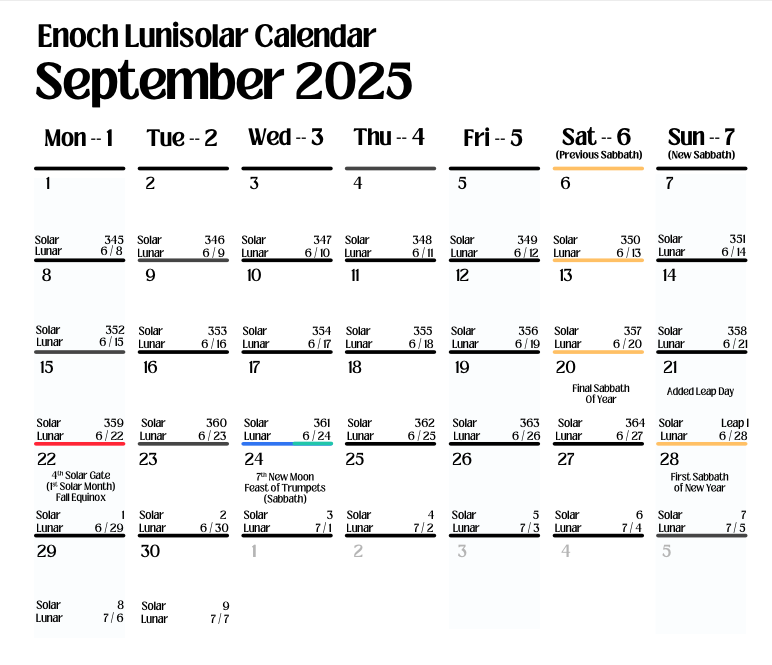
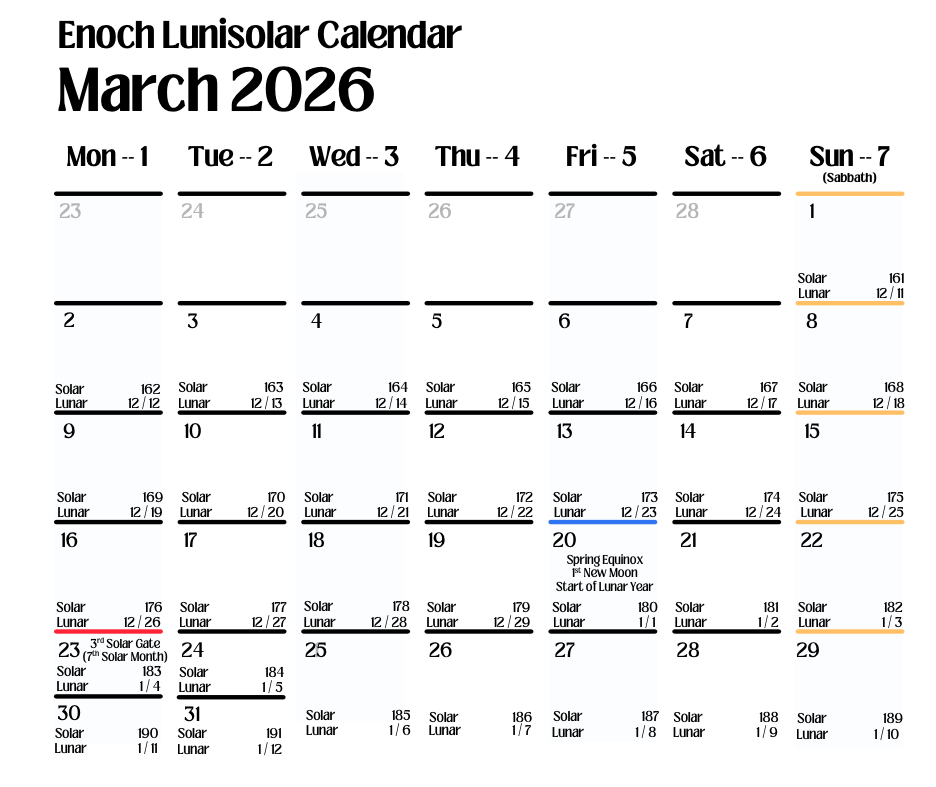
As you can see, the 7th new moon arrived on September 24th, 2025 (or technically the evening of September 23rd), and this was day 3 of the solar year. On March 20th, 2026, the 1st new moon arrives on solar day 180. And remember what I said earlier, any lunar month that begins on day 179 or later is the 1st new moon of the year.
This ‘count-to-7’ rule works every year.
You can also look at it like this: when the 7th new moon arrives on or after the fall equinox (day 1 or later), that lunar year will have 12 months. But, when the 7th new moon arrives before the fall equinox (before day 1), that lunar year will have 13 months — not 12. In those instances, the 8th new moon will be the 1st lunar month to arrive after the fall equinox.
When the 7th new moon arrives before the start of the solar year, then…
- The 8th new moon is the 1st month after the fall equinox.
- The 9th new moon is the 2nd month after…
- The 10th new moon is the 3rd month.
- The 11th new moon is the 4th month.
- The 12th new moon is the 5th month.
- The 13th new moon is the 6th month.
- And the 1st new moon is the 7th month after the fall equinox.
Just as before, the 7th lunar month on or after the fall equinox is still the 1st new moon of the year. The only difference being there’s now 13 lunar month preceding it — not 12.
Here’s a few more calendar examples: September/October 2026 and March/April 2027.
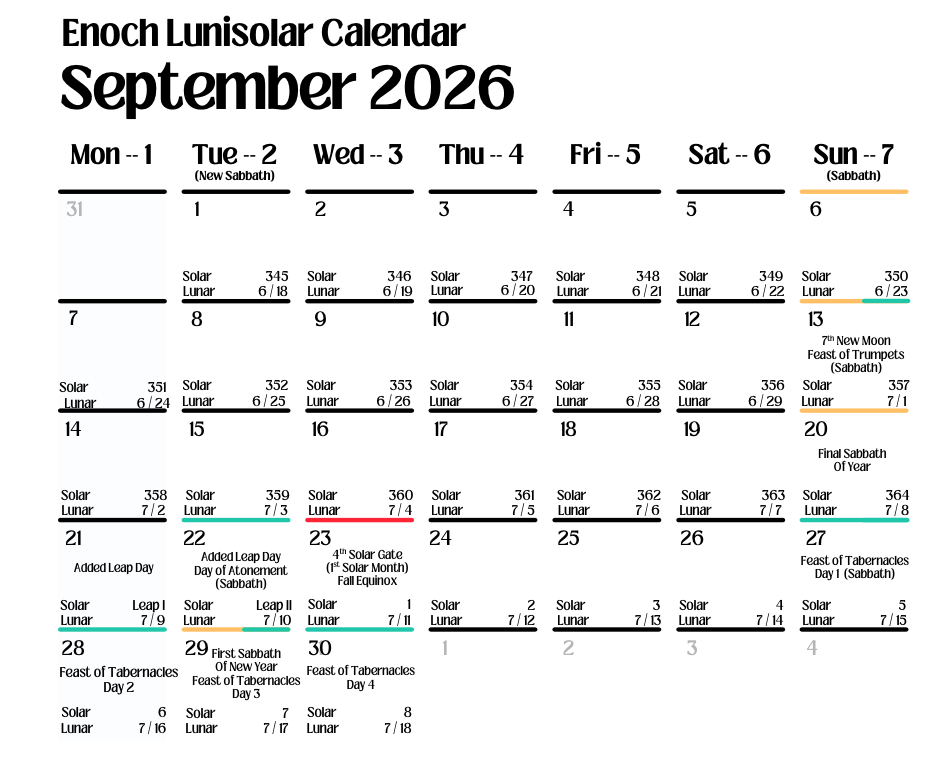
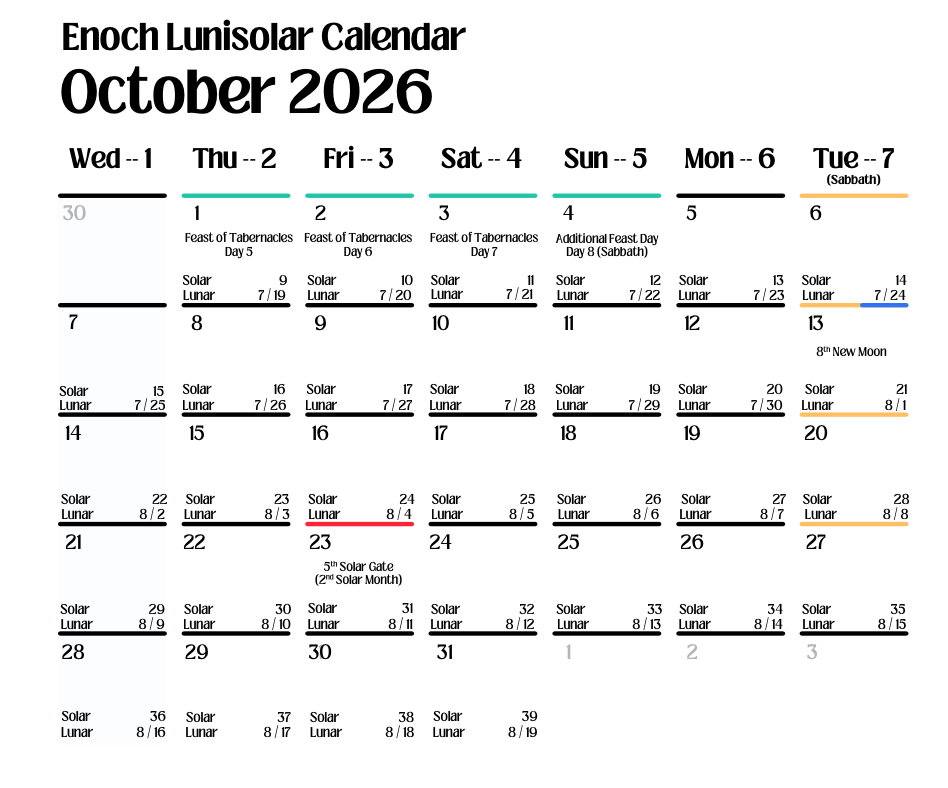
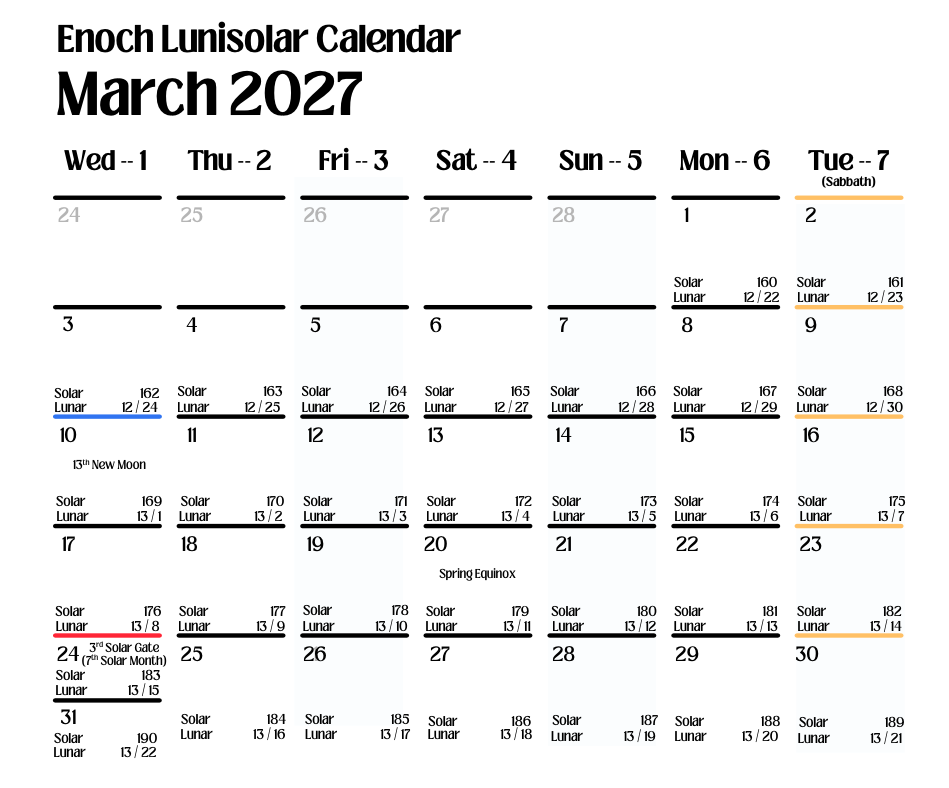
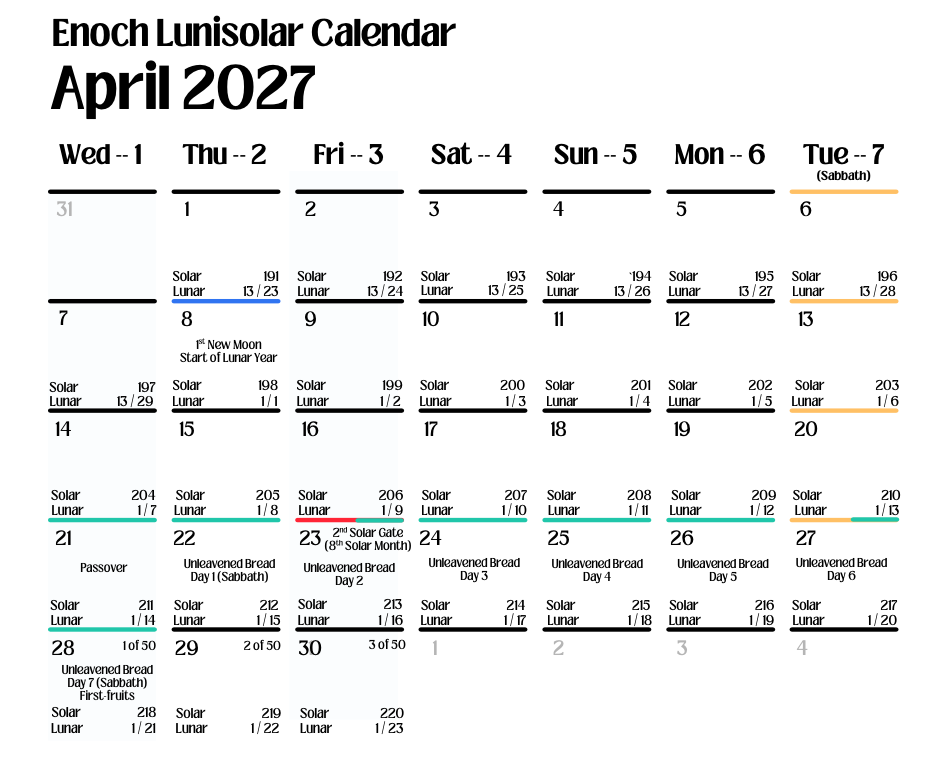
As you can see, when solar day 1 arrives on September 23rd, 2026, the 7th lunar month is already underway. Which means, the 1st lunar month after the equinox is the 8th new moon, which arrives on October 13th, 2026 (or the evening of October 12th). Because of this, that lunar year will have 13 months. This is why the spring equinox on March 20th, 2027 occurs in the middle of the 13th lunar month, and not the 12th. Then on the evening of April 7th, 2027, the 1st new moon of that year arrives.
Got it? I hope so.
Method #1 or Method #2?
Which method do you prefer? Relying on the spring equinox, or counting from the fall equinox? The Father has given us two amazing options for starting the lunar year right, so why not use them both?
Personally, this is what I do: count to ‘7’ from the fall equinox each year, and then use the spring equinox to confirm the 1st new moon.
It’s that easy. You can do it!
Confirmation With The Day Of Atonement / Jubilee Year
Leviticus 25:8-10 — 8 ‘And you shall count seven Sabbaths of years for yourself, seven times seven years. And the time of the seven Sabbaths of years shall be to you forty-nine years. 9 ‘You shall then sound a ram’s horn to pass through on the tenth day of the seventh month, on the Day of Atonement cause a ram’s horn to pass through all your land. 10 ‘And you shall set the fiftieth year apart, and proclaim release throughout all the land to all its inhabitants, it is a Jubilee for you. And each of you shall return to his possession, and each of you return to his clan. (The Scriptures)
The jubilee year may have been the most important year in a Hebrew’s life. A year of liberty and rest throughout all the land. And, it was rare. With each jubilee spaced 49 years apart, most people could only witness two, maybe three at the most. Some never lived to see one. But even though this sacred year felt like a new experience each time it arrived, the start of it was quite familiar…
The Day of Atonement.
That was when the ram’s horn was sounded, and the jubilee was proclaimed. And rest assured, that date was etched on everyone’s schedule. There wasn’t a Torah observer alive who couldn’t tell you when it was…
The 10th day of the 7th month.
Now remember: while the start of the lunar year (what we use for the feasts) is in the spring, the start of the solar year is in the fall. That’s why the jubilee year wasn’t proclaimed until the fall feasts. The lunar year may have been halfway done, but the solar year was just getting underway.
I find it interesting that out of all the feast days in the fall, the Father chose the Day of Atonement to declare the jubilee. There must be a reason, right?
Now, what I’m about to suggest is a theory, not clear-cut in scripture. But perhaps you’ll agree, because I don’t feel it’s an unreasonable thought…
I don’t think they declared a jubilee year before it arrived. Do you? To me, it only makes sense that the previous year must have been over before sounding the ram’s horn upon the new jubilee. Otherwise, they’d be declaring liberty in the wrong year, at the wrong time. And to me, that would be a bit odd.
In modern terms, that would be like this…
Imagine you’re in front of your TV, watching the State of the Union address. It begins when the President is introduced, with a roaring display: “Mr. Speaker, the President of the United States!” Next, everybody in the chamber is on their feet. Some cheering. Some not. Regardless, everyone is prepared to see the President — because his entrance has been declared. But then, something strange happens. The President’s not there. A minute passes. People start muttering. Two minutes. Awkwardness has fully-set in. Before finally, after ten minutes, the President casually waltzes through the doors and starts shaking hands, with an audience that’s now completely befuddled.
… that’s what declaring the jubilee year too soon would feel like.
So here’s what I suggest: since the Day of Atonement is when we proclaim the jubilee for the upcoming year, then the 10th day of the 7th month must come after the previous year is complete. Also, it must be this way every year. Complete consistency. I believe it can be declared during the leap days (365/366), since these days aren’t technically part of the 364-day solar year, but no sooner. The 364-day year (that precedes the jubilee year) must be over, and then the declaration can occur.
What do you think? Does that seem like a possibility? If so, let’s start working backwards toward the 1st new moon, because this is where our topic gets interesting.
The Explanation
As you may already know, lunar months alternate between 29 and 30 days. Occasionally there will be two 30-day months in a row, but never three. Nor will two 29-day months appear back-to-back. Because of this, a 6-month stretch will normally be 177 days, and sometimes 178 days…
- 30 + 29 + 30 + 29 + 30 + 29 = 177
- 30 + 30 + 29 + 30 + 29 + 30 = 178
So, if we add-on the 10 days of the 7th month, to bring us to the Day of Atonement, we now have a stretch of 187 (or 188) days from the start of the 1st new moon. (I’ll be using the typical 187-day stretch for the coming sections…)
- 30 + 29 + 30 + 29 + 30 + 29 + 10 = 187
By placing the Day of Atonement on day 365 — which is after the completion of one solar year and before the start of the next — the 1st day of the 1st lunar month would be on day 179 of the previous solar year…
- day 365 – 186 days = day 179
- (Note: I subtracted 186 and not 187, because day 365 is the 187th day.)
How about that? The start day is the spring equinox.
So to be clear: the earliest day that the jubilee year can be declared, day 365, coincides perfectly with the earliest day that the 1st new moon can begin, day 179. It really is all about the equinoxes, isn’t it?
Now let’s go back to our previous calendar examples, so we can see this all firsthand. On March 20th, 2026, the 1st new moon of the lunar year arrives. This is solar day 180…
Now as we hop ahead 7 months, we can see that the Day of Atonement occurs on day 366, the 2nd added day (leap day).
So if the solar year beginning on September 23rd were a jubilee year, the jubilee would have been declared in the proper time, and not in the previous year.
The other year that’s similar is 2037, when the 1st new moon arrives on day 179, and the Day of Atonement is on day 365, the 1st added day. Once again, if that coming year were a jubilee, it would be declared in the proper time.
That’s pretty neat, right? Not a detail you’d probably think about, but still a way to confirm whether or not we’re in the correct month.
Why Does The Declaration Matter For Every Year?
Perhaps you’re wondering: if the years mentioned aren’t jubilee years, why does it matter where the Day of Atonement lands? It matters because the sun, moon, and stars are on a 19-year cycle, repeating over and over again. Which means that at some point in the past, these years, and every other lunisolar year, have been on a jubilee year. So the rules that apply to a jubilee year must be constant across the board, for each lunisolar year in the 19-year cycle.
In fact, if I may get technical for a moment, there’s a different lunisolar year on each jubilee year before they begin repeating themselves. So for example, when the 1st of the 19 years lines up with a jubilee year, then that lunisolar year doesn’t land on another jubilee year until the other 18 years have had their turn. That’s how the 19-year lunisolar cycle and the 49-year jubilee cycle sync-up, which is fascinating on its own. And this cycle completes itself every 931 years.
- 19 x 49 = 931
Was that essential for you to know? Not really. But darn it, I do find it interesting. Any maybe you do too.
The Year That’s Too Soon
The two years I’ve kept returning to are the ones with the earliest lunar start dates: day 179 in 2037, and day 180 in 2026. I’ve done this because they’re a great way to show how perfectly the Enoch calendar works.
However, what about a year that just missed the spring equinox deadline. Would you be interested to know how that goes? The best example of this would be in 2029, when there’s a new moon on the evening of March 16th. This is solar day 177, and two days before the equinox. This month will not be a 1st new moon of the year, but will instead be a 13th lunar month.
But you know what? When 2029 arrives, there may be people who turn this 13th month into a 1st, and start the year too soon. So just for kicks, let’s see what would happen if we make this the 1st new moon. Will the checks-and-balances tell us that we’ve made a mistake?
Let’s see.
Alright. So remember what I said about the Day of Atonement being the 187th (or 188th) day of the lunar year? Where would that land with a day 177 start? If solar day 177 were the 1st day of the 1st lunar month, then the 187th lunar day would be the 363rd solar day.
- day 177 + 186 days = day 363
- (Note: I added 186 and not 187, because that gets us to the 187th day.)
See the problem? If this lunar year were leading into a jubilee year, then the jubilee would be declared too early — in the wrong year. That’s because the Day of Atonement (7/10) would arrive before the year is complete, on day 363. This is just further confirmation as to why we begin the lunar year at the spring equinox, and not a day sooner.
By the way, 2029 is the latest start date we experience for the lunar year. The 1st new moon won’t arrive until the evening of April 14th. Mark your calendars!
Concerning The Barley Harvest…
One last thing I want to touch on is the barley harvest. I know that there’s Torah observers who rely on a barley harvest report in Israel to determine when the 1st new moon begins. And believe me, I understand the logic. Since the feasts of Yah are agricultural in nature, commencing them at the time of harvest makes sense in many ways. But with that being said, I don’t believe it’s the right way.
Exact dates for harvest can change with the climate. It could be off by weeks, months, or more based on drought alone. When there were famines in times past, how did they start the year? And how will we begin the year in the future if, and when, days of hardship return? That’s why I don’t rely on the barley harvest to start the lunar year, nor have I found any scripture to say that we should be doing so…
(The closest scriptural example I see for applying agriculture to the calendar is the count to Pentecost, when we’re told to number seven weeks from the time we place the “sickle to the grain” [Deuteronomy 16:9]. But, the lunar year has already begun and moved into the 3rd week — the Feast of Unleavened Bread. So even here, this scripture doesn’t apply.)
… The luminaries, however, are constant. They’re perfect, precise. Now it’s true: one day the sun will go dark and the moon will turn to blood [Joel 2:31], but we’re not there yet. Until then, I’ll be using them to determine all my calendar needs. Because after all, that’s one of the reasons they were created.
Genesis 1:14 — And Elohim said, “Let lights come to be in the expanse of the heavens to separate the day from the night, and let them be for signs and appointed times, and for days and years. (The Scriptures)
In Summary
There’s two lines in the sand that we don’t cross…
The first is the spring equinox in March — even though it may be tempting! A lunar month that begins before the spring equinox is either a 12th or a 13th new moon; and a lunar month that begins on the equinox (day 179) or later is the 1st new moon.
The second line we don’t cross is the fall equinox in September. Remember, if the 7th new moon arrives before the equinox, that year is going to have 13 months. But, if it arrives on or after the equinox, only 12 months.
Which reminds me…
A Poem Before You Go?
Calendars, numbers, and various methods are all great to learn, but sometimes you need something catchy to remember. Hopefully, this is just that. I put together a quick poem to help you know whether a lunar year will have 12 or 13 months. Because at the end of the day, it’s all about when you blow the trumpet for the Feast of Trumpets, or Yom Teruah — which is the 1st day of the 7th new moon.
If the trumpet’s blown before the solar year begins, then you’ll have 13 lunar months. But, if it’s blown on or after the start of the solar year (day 1), then there will be 12 lunar months.
Anyway. Call this ‘The Poetic Method.’ Enjoy.
Blow the trumpet before day one,
thirteen months you’ll see.
But blow it on or after day one,
twelve months is all you need.
Thank you so much for reading. And until next time… stay in that thin gate.
— Daniel A., Creator of ThinGate.org