Introduction
So. You want to start the biblical year with the equinox, but making a sundial isn’t within your reach at the moment? I understand. While nothing beats the accuracy of tracking the equinox with your own sundial, maybe it isn’t feasible where you live. Or, perhaps you made a sundial, had all your equipment ready to go, but then — BAM! A week of rain! It happens. Whatever the reason may be, there are alternatives. Not perfect alternatives, mind you; but as long as you have the internet, you have a good chance of getting the day right.
I’ll show you how.
What Exactly Is The Equinox?
I want to clear up a common misconception before going further. The equinox is not the moment of equal day and equal night. It’s close. Very close, actually. Just a couple days separate the two (from my understanding). So just know, when tracking the equinox you’re not looking for equality of light.
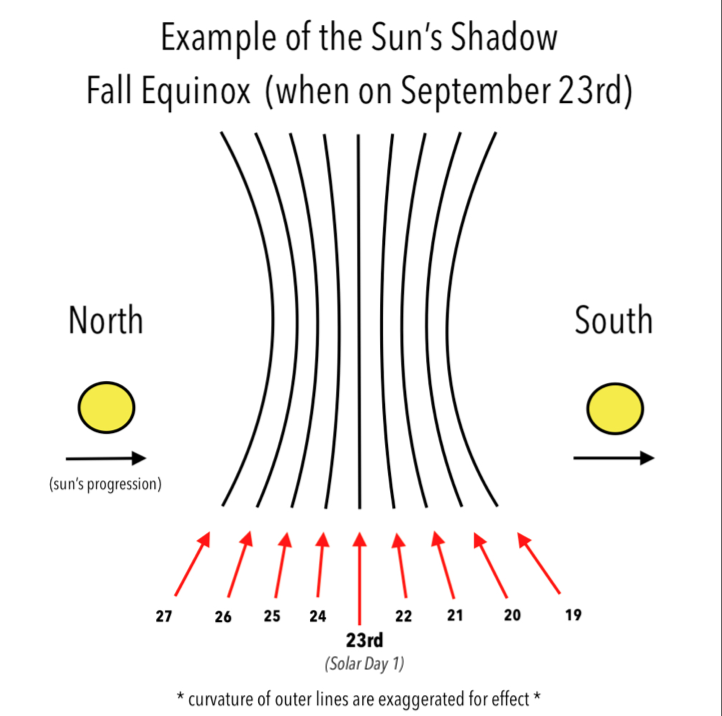
The equinox is the day the sun shifts from one side of the sky to the other. North to south (September), or south to north (March). This creates a straight line, casting a level shadow from morning to evening…
- (Though the equinox could also have a slight curve, which I’ll touch on later.)
… So for example, when we’re looking at the the fall equinox, the day before the equinox has a shadow that bows southward, and the day after has a shadow that bows northward.
As in this picture…
The Hebrew word for this phenomenon is ‘tequphah’ (תקופה); and it refers to the sun’s circuit, or the turning of the year.
Psalm 19:4-6 — 4 Their line has gone out through all the earth, And their words to the end of the world. In them He set up a tent for the sun, 5 And it is like a bridegroom coming out of his room, It rejoices like a strong man to run the path. 6 Its rising is from one end of the heavens, And its circuit (ותקופתו) to the other end; And naught is hidden from its heat. (The Scriptures)
If you’re familiar with my articles, you know that the fall equinox (September), or tequphah, is what begins the year. It’s not the spring equinox (March), like many believe…
- (If this is a new concept for you, you can check that out here: “When Does the Biblical Year Begin?”)
… That’s why I’ll be focusing on the fall equinox. Though I will touch on the spring equinox at the end for some interesting notes.
Now, what’s the first step to finding the equinox without a sundial…?
Running On Jerusalem’s Time
I’m a believer that the land of Israel is the center of, well, everything. Everything on earth, anyway. And I believe this for a few reasons…
- Mount Zion is said to be “the navel of the earth” in the book of Jubilees [8:19].
- The land of Israel is alluded to being the “center of the world” in Ezekiel [38:12].
- 1 Enoch chapters 25-26 describes an end time judgement taking place in the middle of the earth, which appears to be either Armageddon or Gog and Magog. Both of which occur in the land of Israel.
And interestingly enough, Israel is really close to the center on most world maps. I don’t think that’s a mistake.
Excuse my red arrow, Europe. It’s for a good cause…
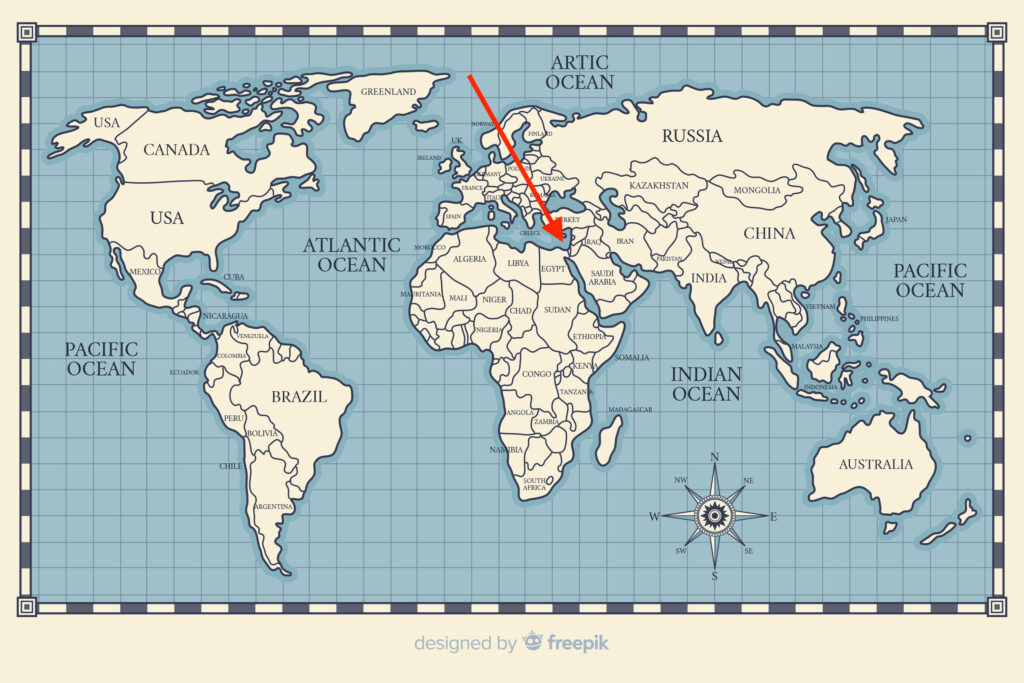
Because of these things, when I’m trying to establish a time to go by with the Enoch calendar, I usually resort to Jerusalem time. I’ll ask myself: “Where’s the sun over Jerusalem?” or “What’s the moon phase over Jerusalem?” I may also check references in the far East (Japan) or the West (the Americas), but there’s something about that central, Israeli time. It’s special.
Jerusalem time will help you find the fall equinox.
What I’m about to share are calculations I’ve made. I’ve taken my own research on the sun and moon cycles and combined it with modern data on the fall equinox — specifically in Jerusalem. I’m not going to put my hand on the Bible and swear this is a perfect, infallible method. It’s not. The only ‘perfect’ method is using a sundial on a clear, sunny day. But nonetheless, I do believe this is accurate — at least for several more years. I wouldn’t share it with you if I had doubts, because starting the solar year on the right day is something I take very seriously. (Wait, that sounded too intense.) … starting the year on the right foot is a big deal, man! (A little better.)
Here’s The Answer…
A quick internet search can tell you the exact minute of an upcoming equinox. Even though the response you receive may be an oversimplification of how the equinox works, it’s still effective — to an extent. We can work with it.
I’ll be using the 2029 fall equinox as my first example. Here’s what you do…
— Type into your search engine: “fall equinox time Jerusalem 2029.”
— The results should tell you that the fall equinox is on September 22nd, 8:37 PM (2037) IDT. (Israel Daylight Time).
- Q. Does that mean the 1st day of the solar year is on September 22nd, 2029?
- A. Not quite. We have to understand that the biblical day begins at sundown. This is key, and it’s the reason why Israeli time is successful, where times in the West would fail.
>>> 6:35 PM (1835) <<<
Remember that time. That’s sundown time in Israel at the time of the fall equinox, give or take a few minutes; and it’s about that time every year. So don’t forget it! Now, for 2029, since the equinox arrives after sundown on September 22nd, the day of the fall equinox will be on September 23rd. Which means…
Day 1 of the solar year in 2029 is September 23rd.
Does that makes sense? If the equinox comes before sundown, the equinox is applied to that same Gregorian day. But if the equinox is between sundown and midnight, it’s applied to the next Gregorian day. I think you got it.
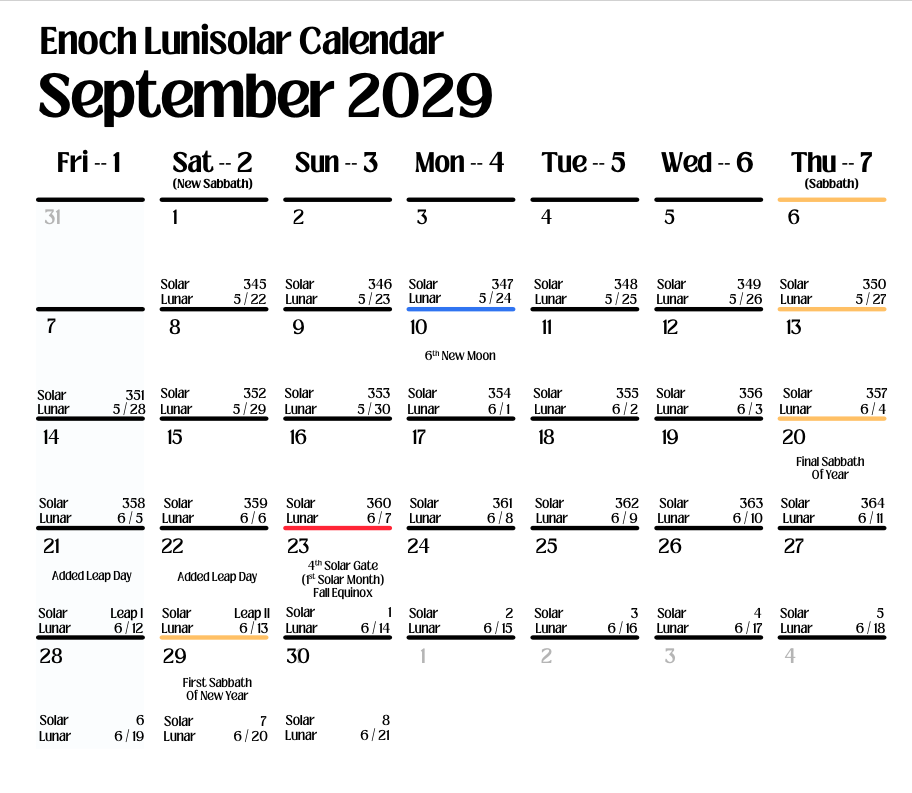
So even though a quick search would tell you the fall equinox is on September 22nd, you must take sundown into account. Thus, September 23rd, 2029 is day 1 of the solar year. Day 7 of the year, which is the yearly sabbath, is September 29th. That’s a Saturday. Which means Saturday will be the sabbath starting in September 2029, and it will remain that way until the fall equinox of the following year.
Here’s a calendar example…
(For more information on why the sabbath resets with the fall equinox, check out: “Finding the True Sabbath on Enoch’s Calendar.”)
Alright, you probably have this down. But let me walk you through one more year, then I’ll give you a table for more years that you can work out on your own.
For 2026…
The fall equinox time in Jerusalem is on September 23rd at 3:04 AM. Since the equinox comes after sundown of the 22nd, and before sundown of the 23rd, September 23rd is the official day of the fall equinox. Pretty straightforward. And day 1 of the solar year is September 23rd, 2026.
Here’s another calendar example…
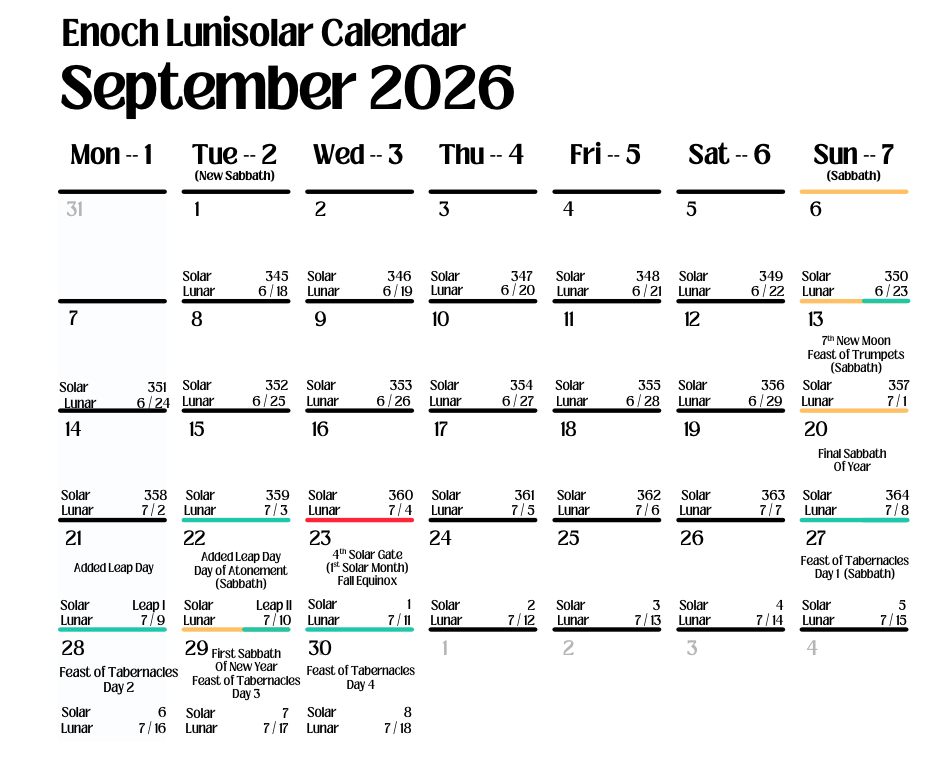
And as you may have noticed, the 7th day of this year is on the weekday of September 29th, a Tuesday. Which means the weekly sabbath will be kept on Tuesday until the next fall equinox, in 2027.
Table For 15!
As promised, here’s an extended list of fall equinox times to help you out. You can practice the method, and then check the answer to see if you’re right. (Or, just check the answer — I won’t tell.)
It’s 15 years, from 2026 to 2040.
FALL EQUINOX TIMES IN JERUSALEM ><><>< ENOCH CALENDAR EQUIVALENT
Year | Date | Time | Enoch Day 1 | Weekly Sabbath |
2026 | September 23rd | 3:04 AM (0304) | September 23rd | Tuesday |
2027 | September 23rd | 9:00 AM (0900) | September 23rd | Wednesday |
2028 | September 22nd | 2:44 PM (1444) | September 22nd | Thursday |
2029 | September 22nd | 8:37 PM (2037) | September 23rd | Saturday |
2030 | September 23rd | 2:26 AM (0226) | September 23rd | Sunday |
2031 | September 23rd | 8:14 AM (0814) | September 23rd | Monday |
2032 | September 22nd | 2:09 PM (1409) | September 22nd | Tuesday |
2033 | September 22nd | 7:50 PM (1950) | September 23rd | Thursday |
2034 | September 23rd | 1:38 AM (0138) | September 23rd | Friday |
2035 | September 23rd | 7:38 AM (0738) | September 23rd | Saturday |
2036 | September 22nd | 1:22 PM (1322) | September 22nd | Sunday |
2037 | September 22nd | 7:11 PM (1911) | September 23rd | Tuesday |
2038 | September 23rd | 1:01 AM (0101) | September 23rd | Wednesday |
2039 | September 23rd | 6:48 AM (0648) | September 23rd | Thursday |
2040 | September 22nd | 12:43 PM (1243) | September 22nd | Friday |
Note: sundown in Jerusalem is approx. 6:35 PM (1835). All times in IDT (Israel Daylight Time)
Here’s The Limitations…
I did say this method was good to an extent, right? Because the Creator’s calendar is perfect, and man’s calendar is not, we don’t always get the equinox times right. Even though the leap years from the Enoch calendar and leap years from the Gregorian calendar are very close to each other over the long run, there are slight differences along the way. They don’t always align.
What’s that mean for you?
The method I’ve shown is only good through the 2040 fall equinox. After 2040, it’s mostly good — not perfect. And we want perfection, right? So let’s make a deal. By the year 2040, you’re going to be using a sundial to mark the equinox. I think that’s reasonable, don’t you? You’re going old school! (I say that playfully, of course.)
But seriously, 2040. That’s the deadline.
Why Not Just Tell Me???
Could I have just given you a list of start dates for the solar year and called it a day? Probably. Could I give you even more dates, beyond 2040? Maybe. But that’s not going to help you much over time. I want you to get your feet wet with a general understanding of how the luminaries work. Now you have a simple method to work with, along with the answers to double-check your work. And eventually, hopefully, you’ll be tracking the equinoxes on you own with a sundial.
We need to be honest with ourselves: the internet may not always be here for us. There could be dark days ahead; and it’s important that we learn how to do these things now, on our own, should that time arrive sooner than we think. That’s why I’m so happy to be sharing this information. But at the end of the day, let it be a stepping stone towards your full, solar-tracking independence. That’s the goal.
You can do it!
And when you’re ready for that step, check out this video…
So What’s Wrong With The Spring Equinox?
Not a thing. It’s important too, but it serves a different purpose from the fall equinox. Unlike the fall equinox, the spring equinox (in March) doesn’t begin the solar year, though it is the marker for the lunar year. Once the spring equinox occurs, the 1st new moon on/or after that date is the start of the lunar year…
- (For more details on the start of the lunar year, check out this article: “Which New Moon Begins The Lunar Year?”)
… For most years, everything surrounding the spring equinox will go as expected: the shadows of the spring mirror the shadows of the fall, with two curves separated by a straight line.
Like this…
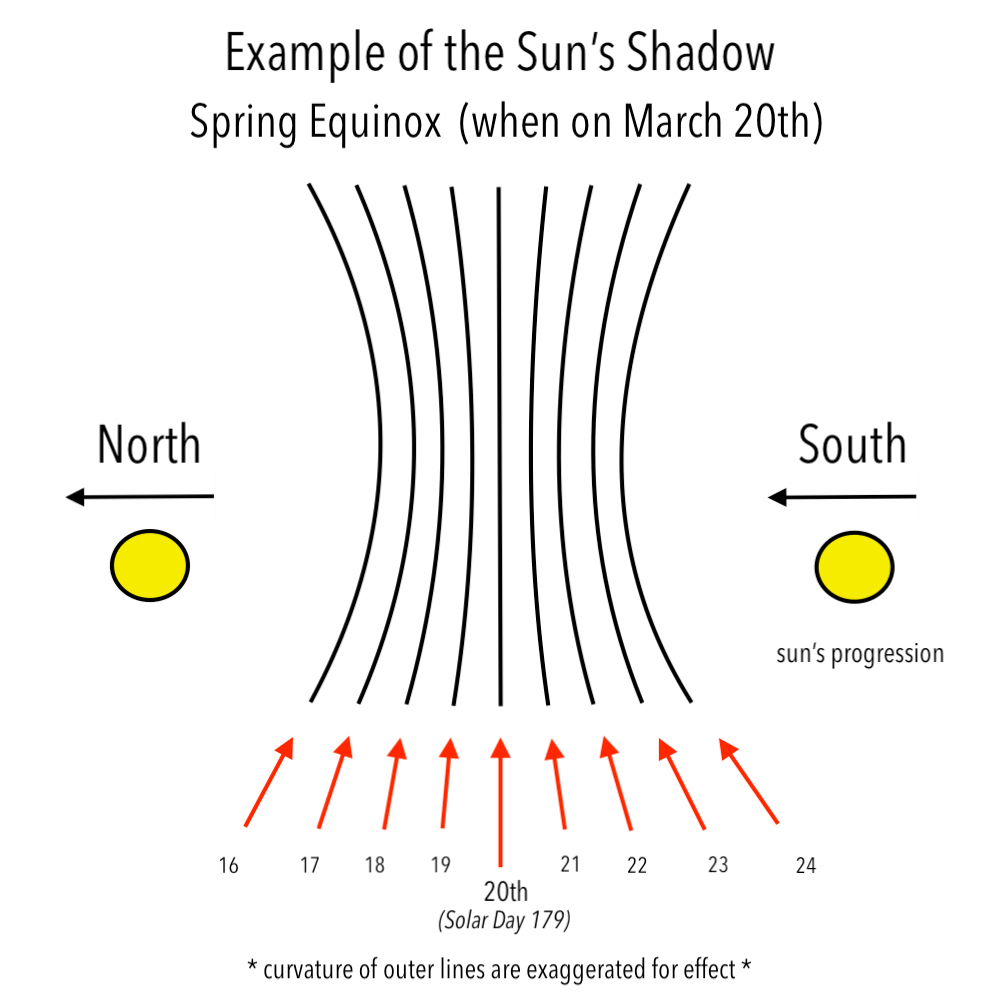
But as strange as it may seem, the spring equinox doesn’t always repeat this pattern; and that’s due to leap years. When the solar year is about to add an additional day (leap day), the sun’s movement shifts backward, ever so slightly. And as that one extra day enters the fold, the pattern is altered. Not by much, but just enough to where the spring equinox no longer has a straight line on day 179.
Instead, we have something like this…
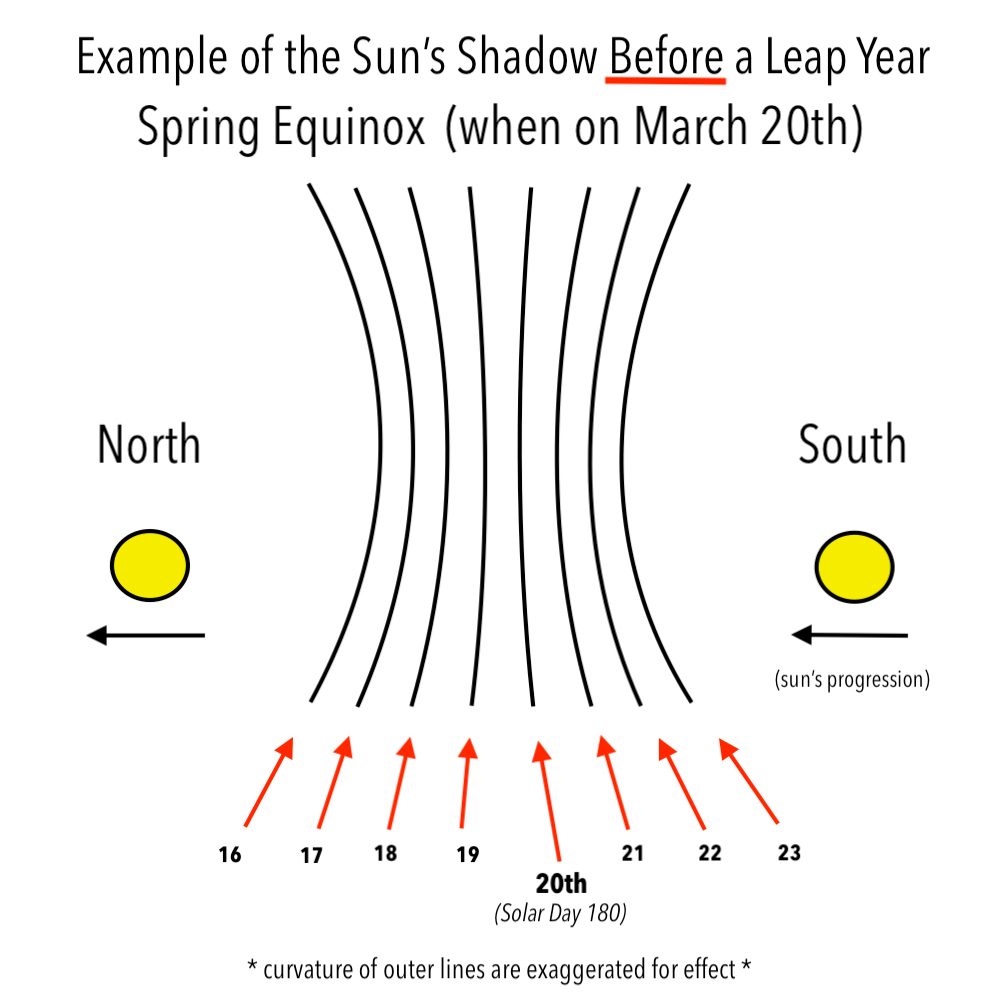
Now, there’s two less pronounced curves that mirror each other, with no straight line dividing them. A slight curve north on day 179 (March 19th) and a slight curve south on day 180.
First time I saw this I thought I had made a mistake; and I continued thinking that over the next few years. But then, it happened again. A lightbulb went off in my head, as I finally put the pieces together. That one extra day (the 366th) can affect the spring equinox. It’s fascinating. Though to be honest, I’m still trying to figure out exactly which years the leap day affects. It would make sense if it was only on the spring equinoxes of the leap year, but it doesn’t appear to be that simple. In time, hopefully that will become clear.
I suppose it’s a good reminder that there’s always something to learn!
Though, leap year or not, there is one constant: the shadow on solar day 180 is the first day that bends southward. That doesn’t change. On a normal year, there’s a straight line on day 179, then a curve south on day 180. Then on years preceding the leap year, there’s a slight curve north on day 179, and a slight curve south on day 180. That’s why I believe that day 179 is the March equivalent to day 1 in September, and day 180 is the day that the sun has completed its turn, it’s tequphah — or, when it’s made a 180 degree turn….
… a 180 on 180…. that can’t be a coincidence, can it?
I bring all this up because if you want to track the spring equinox without a sundial, it won’t be as easy to accomplish as the fall. Not impossible, just different. But as long as you understand the differences leading up to it, that’s what matters.
Though as I write this… I wonder if that rule still applies in the southern hemisphere? Hmm. Where are my brothers and sisters from down under at? Let’s figure this one out.
Thank you so much for reading. And until next time… stay in that thin gate.
— Daniel A., Creator of ThinGate.org