Introduction
For those who keep the sabbath on Saturday, I have bad news….
That’s not the right day. And if you keep a lunar sabbath, I’m afraid you’re in the same boat. But you know what? I used to be in that boat too. I kept the lunar sabbath for a time, and then I kept the Saturday sabbath even longer. So please know before we start, I’m not pointing fingers or judging. I would only be condemning myself if I did. What I will be doing, however, is (lovingly) explain why these sabbaths are incorrect, with scriptural evidence that you probably haven’t considered.
But, here’s the good news….
The true sabbath is so much better; and it can be kept by learning the Enoch calendar. (Coming to a sky near you!) I like to think of this calendar as our heavenly Father’s personal clock, and it’s there for all his children to use.
Though I won’t deceive you: keeping the true sabbath will require an adjustment on your part. But, if you’re willing to accept it and alter your schedule just a bit, I believe the Father will be pleased. I really do.
Now let’s get to it.
A Brief Overview
The Enoch calendar is lunisolar in nature, meaning it uses both the moon and the sun. But it’s the solar portion where we receive the weekly sabbath.
(By the way, did you know that the solar year doesn’t begin in the spring, but in the fall? If not, you may want to check out this article before going any further: “When Does The Biblical Year Begin?”)
It’s possible that you’re tired of researching this topic, so I don’t want to delay your rest any longer than need be. I’m going to cut to the chase and tell you exactly when the true sabbath is, and how you can find it on your own, year after year. Then, I’ll explain how I reached this conclusion, as well as why the other sabbath options are incorrect. That’ll take a little more time; but if this is a topic you take seriously (and I hope it is), it will be well worth it.
How To Find The True Sabbath
Once the year begins at the fall equinox (on September 22nd or 23rd), we can determine the sabbath for the next 52 weeks. And that’s the kicker: it’s only for 52 weeks. When the next solar year begins, the sabbath shifts back 1 or 2 days on our 7-day week. Why? Because even though Enoch’s calendar is a precise 364-day/52-week count, it requires a leap day (or two) between years to bring us back to the equinox. Otherwise it would fall further and further out of line over time.
Here’s an example from the September 2025 calendar. (Explanation below.)
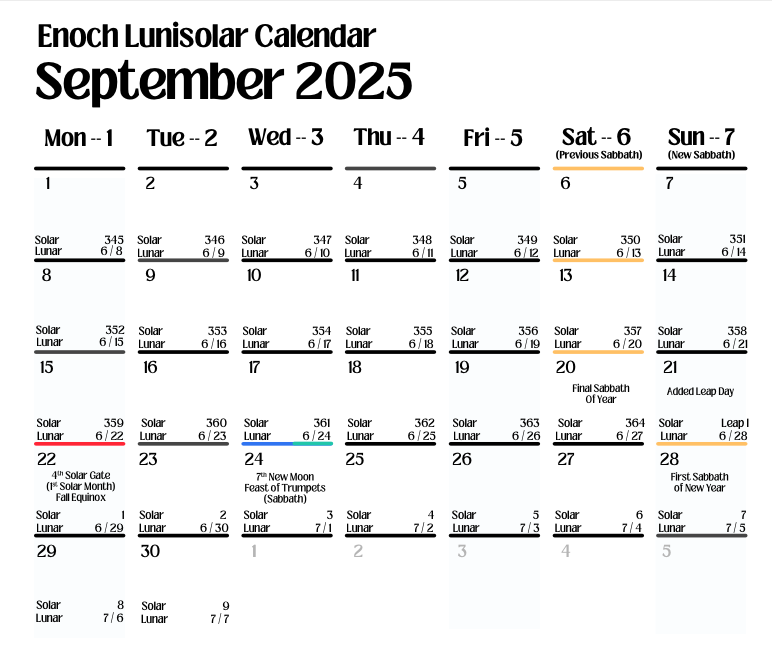
From September 2024 to 2025, the sabbath was on Saturday. For 52 Saturdays, to be exact. Then, September 20th was the final sabbath of that year, which was solar day 364. September 21st is an additional day (leap day) before the fall equinox on September 22nd. The day of the equinox is day 1 of the next solar year. From here, we count to 7; and as you can see, the first sabbath of the new year is on September 28th, 2025. With one additional day this year (on September 21st), the sabbath goes from Saturday to Sunday; and it will be on Sunday for (you guessed it) 52 weeks, until September 20th, 2026. This backwards shift repeats year after year.
If there were two additional days instead of the one, the sabbath would have gone from Saturday to Monday. This occurs every 4 years, on average — much like our modern leap day in February. The next time this occurs is the following year, conveniently enough, in September 2026. Here’s an example of what that looks like.
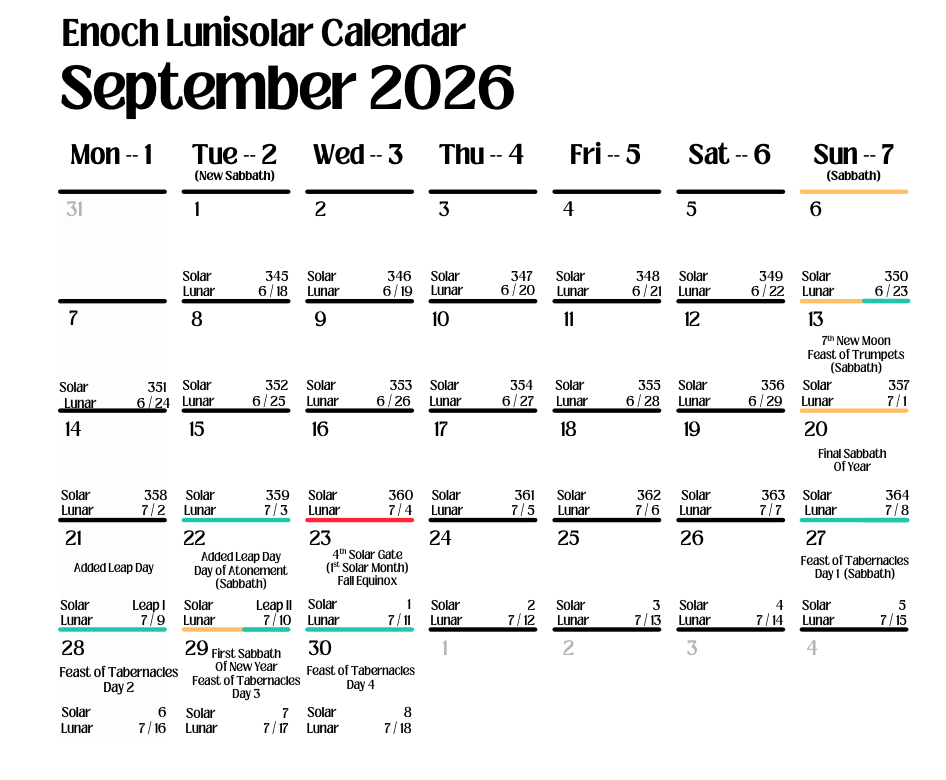
As you see, the 364th day, or the final sabbath of the solar year, is on September 20th, 2026 — a Sunday. Then, there’s two leap days on September 21st and 22nd. From here we reach the fall equinox on the 23rd, which is day 1 of the next solar year. After this we count to 7, and then reach the new year’s sabbath on September 29th — a Tuesday.
That’s the difference between a 365-day and 366-day solar year. Subtle, but important to know. The sabbath will always push back 1 or 2 weekdays at the end of September.
So The Sabbath… Moves???
Yes it does.
Contrary to popular belief, the sabbath is not stationary. It’s not a day that can be found on our Sunday through Saturday week, and then be kept the rest of our lives. That may seem logical with today’s calendars, and with our modern perspectives, but on the Creator’s calendar — it’s not. When our days are perfectly aligned to the sun, moon, and stars, it’s actually necessary for the sabbath to shift from year to year.
Here’s why.
Passover Is The Key
Early on in my quest to find the true sabbath, I had a theory. A single, uncompromising thought that I felt could narrow down my search. I believed that whenever the sabbath was, it could never land on the same day as Passover. Not once. Not ever. I believed this for two reasons.
Here’s my first…
1.) The Passover is a preparation day for the Feast of Unleavened Bread; and preparation days come before the sabbath, when we complete all our work before resting.
To show this, we’re given a witness in each of the gospel accounts. When the Messiah was crucified on Passover, as our Passover lamb, it was also called “preparation day.”
Luke 23:53-54 — 53 And taking it down, he wrapped it in linen, and laid it in a tomb hewn out of the rock, where no one was yet laid. 54 And it was Preparation day, and the Sabbath was approaching. (The Scriptures)
- (Check out Matthew 27:59-62, Mark 15:42-43, and John 19:14, 31, 42 for more witnesses.)
It makes sense the Passover is considered a preparation day, does it not? There’s a lot of work to be done as we prepare for the Feast of Unleavened Bread; and the 1st day of the feast actually is a sabbath. How could we prepare for the feast if there were two sabbaths in a row? I’m not sure that’s even possible.
Here’s my second reason…
2.) Do you know the command that was given to the children of Israel when it came to preparing the Passover offering? It must be roast in fire.
Exodus 12:8-9 — 8 And they shall eat the flesh on that night, roasted in fire – with unleavened bread and with bitter herbs they shall eat it. 9 Do not eat it raw, nor boiled at all with water, but roasted in fire, its head with its legs and its inward parts. (The Scriptures)
This was the detail that sealed it for me, because one of the things we are not permitted to do on the sabbath is kindle a fire.
Exodus 35:3 — Do not kindle a fire in any of your dwellings on the Sabbath day. (The Scriptures)
Now, I could make an argument that it’s the kindling of a fire that’s prohibited, and not the fire itself. But even so, that doesn’t take away from the fact that Passover required slaughtering an animal, cooking it, as well as all the other preparations that came for the feast. That’s still a lot of work to be done.
Think about this: would the Father ever give a command that broke another one of his commands? Absolutely not. His ways are perfect, unchanging. With that truth in mind, this only further cemented my original thought….
- The Passover and the sabbath can never be on the same day.
And not only the Passover, but the 2nd Passover too. Don’t forget, in Numbers 9 an additional command is given, permitting the Israelites to keep Passover a month later if they are traveling or due to uncleanness. So now, my search got even tighter…
- The Passover and the 2nd Passover can never be on the sabbath day.
Boy, this was getting intense. Two days a year, every year, that the 7th day of the week could never hit. Was that even possible? It had to be. But I had to find it. I had to prove it. And I was going to stop at nothing until I did.
The Wrong Sabbaths
Right away I was able to eliminate the two sabbath options mentioned earlier. The first was the Saturday sabbath, because it’s a stationary day of the week. And because it doesn’t shift with the luminaries, Passover will inevitably land on Saturday at some point. For example in 2015 and 2022, Passover was on a Saturday. No bueno.
The second sabbath option was the lunar sabbath. For those who are unaware, some people keep the sabbath according to each lunar cycle. When the new moon arrives, the sabbath resets, and will be on the 7th, 14th, 21st, and 28th of that lunar month. I understand the logic, but here’s the problem: Passover is on the 14th of the 1st month. So when you’re keeping a lunar sabbath, every year the sabbath and Passover are in violation of each other. Yikes.
The Right Sabbath (With Results)
With Saturday and the moon out of the way, it was on to the solar calendar. I tried several different options across the solar spectrum; and with each one that failed, I could tell I was getting closer. Eventually, with sheer grit and determination, I found what I was searching for: a consistent 7th day on the Enoch calendar that never falls on Passover. And thankfully, it’s not too hard to find — once you know where to look.
But first, let me prepare you a moment….
In case you don’t know, the sun and moon travel in 19-year cycles. After 19 years, they repeat. And this cycle never stops. So for example, if the 29th day of the 6th lunar month is on day 1 of the solar year (as in 2025), then in 19 years (2044) the same days will realign. The pattern is immaculate.
With that understanding, you just need to find the lunisolar pattern over a 19-year period. Then, you can go backwards and forwards, knowing the pattern for as long as the sun and moon have endured, and will endure. That’s easier said that done, believe me. But it is possible. With the Father’s help, all things are.
Alright, with that preparation out of the way, it’s time for the results. This is what the Passover calendar looks like when we start the solar year on the fall equinox. On the left-side of the table, I have Passover and 2nd Passover. Above them are the 7 days of the solar week (1st day, 2nd day, etc.). And in each box I’ve calculated the number of times that Passover and 2nd Passover land on each day.
Check it out.
When Starting The Solar Year On The Fall Equinox (September)
1st Day | 2nd Day | 3rd Day | 4th Day | 5th Day | 6th Day | 7th Day | |
Passover | 4x | 2x | 3x | 3x | 3x | 4x | None |
2nd Passover | 4x | 2x | 2x | 5x | None | 6x | None |
What do you think? Are you as speechless as I was? I hope so. Because personally, I’ve never seen a greater piece of evidence attesting to our Creator, יהוה, than this. The sun and moon literally revolve around keeping his feasts. The Passover falls on each day of the week multiple times, except for the 7th day. Same with 2nd Passover. The only difference is it never falls on the 5th day either for 2nd Passover, and I believe that’s a result of the empty 7th day for the Passover slot shifting back a month. Either way, this is what convinced me that the starting point of the year is the fall equinox, and that the sabbath is 7 days later.
Here’s the same calendar example from 2026, just to give you a better idea of what this looks like. As you’ll see again, day 1 of the solar year is on September 23rd. For the lunar year, this is the 11th day of the 7th month. Tuesday will be the sabbath starting on September 29th — the 7th day from the equinox.
Now hopping ahead to April 2027, we can see where the 1st lunar month aligns on the solar (and Gregorian) calendar. The 1st day is on April 8th, which is solar day 198, and the 2nd day of the solar week (Thursday). Move down two weeks and you’ll see Passover is on April 21st. That’s the 1st day of the solar week (Wednesday), and thus, Passover does not land on the sabbath.
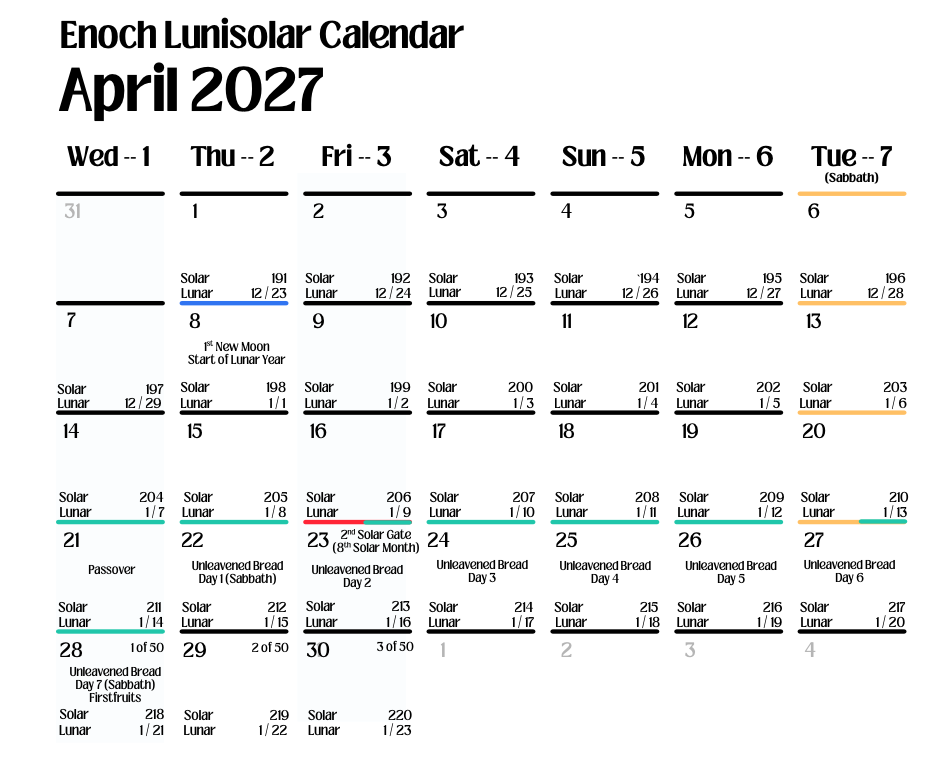
I don’t have an online calendar made for all 19 years (yet), but I do have one for September 2025 to December 2027, and you’re more than welcome to use it. You can find it HERE, absolutely free. Take it and share it. Nothing would make me happier than to know you and I are keeping the same sabbath and feast days. Enjoy.
Though if you would like to double-check my work (and I’m not offended if you do), I don’t want to leave you hanging. I’ve put together a table of when Passover and 2nd Passover fall over a 19-year window — from 2009 to 2027. You can see the Gregorian date, the Enoch solar day, as well as the Enoch weekday.
Passover and 2nd Passover Dates
Year | Passover | Solar Day | Weekday | 2nd Passover | Solar Day | Weekday |
2009 | Fri. April 10th | Day 201 | 5th of Week | Sat. May 9th | Day 230 | 6th of Week |
2010 | Wed. April 28th | Day 219 | 2nd of Week | Fri. May 28th | Day 249 | 4th of Week |
2011 | Mon. April 18th | Day 208 | 5th of Week | Tue. May 17th | Day 237 | 6th of Week |
2012 | Fri. April 6th | Day 197 | 1st of Week | Sun. May 6th | Day 227 | 3rd of Week |
2013 | Thu. April 25th | Day 216 | 6th of Week | Sat. May 25th | Day 246 | 1st of Week |
2014 | Mon. April 14th | Day 205 | 2nd of Week | Wed. May 14th | Day 235 | 4th of Week |
2015 | Sat. April 4th | Day 194 | 5th of Week | Sun. May 3rd | Day 223 | 6th of Week |
2016 | Fri. April 22nd | Day 213 | 3rd of Week | Sat. May 21st | Day 242 | 4th of Week |
2017 | Tue. April 11th | Day 202 | 6th of Week | Thu. May 11th | Day 232 | 1st of Week |
2018 | Sun. April 1st | Day 192 | 3rd of Week | Mon. April 30th | Day 221 | 4th of Week |
2019 | Fri. April 19th | Day 209 | 6th of Week | Sun. May 19th | Day 239 | 1st of Week |
2020 | Wed. April 8th | Day 199 | 3rd of Week | Thu. May 7th | Day 228 | 4th of Week |
2021 | Tue. April 27th | Day 218 | 1st of Week | Wed. May 26th | Day 247 | 2nd of Week |
2022 | Sat. April 16th | Day 207 | 4th of Week | Mon. May 16th | Day 237 | 6th of Week |
2023 | Wed. April 5th | Day 195 | 6th of Week | Fri. May 5th | Day 225 | 1st of Week |
2024 | Tue. April 23rd | Day 214 | 4th of Week | Thu. May 23rd | Day 244 | 6th of Week |
2025 | Sun. April 13th | Day 204 | 1st of Week | Mon. May 12th | Day 233 | 2nd of Week |
2026 | Thu. April 2nd | Day 193 | 4th of Week | Sat. May 2nd | Day 223 | 6th of Week |
2027 | Wed. April 21st | Day 211 | 1st of Week | Fri. May 21st | Day 241 | 3rd of Week |
And in case you’re wondering (because I was) how many times Passover and 2nd Passover fall on each day of the Gregorian week, look at this.
Sun. | Mon. | Tue. | Wed. | Thu. | Fri. | Sat. | |
Passover | 2x | 2x | 3x | 4x | 2x | 4x | 2x |
2nd Passover | 3x | 3x | 1x | 2x | 3x | 3x | 4x |
On the Gregorian calendar, no weekday is safe. In a 19-year period, the Passover and 2nd Passover hit them all multiple times. 4-6 times on each day between the two of them. Compare that to the Enoch calendar week, where the 7th day doesn’t receive a single Passover or 2nd Passover landing. That’s a big difference; and that’s why, for me, it’s clear: the Gregorian should have no place in our biblical calendar walk.
Now, this all looks great for my presentation; and to the best of my understanding each date I’ve given is accurate and true. Though I do acknowledge that if you were to look up Passover dates on your own, you’ll find a lot of variations. Typically they’ll be a day sooner, and sometimes a month sooner. That’s because many people have a tendency to begin the new moons a day early, and sometimes begin the lunar year early as well — which is a real problem. If you would like clarity on these topics, check out “Which New Moon Begins The Lunar Year?”
Subscribe HERE for updates on future Biblical Calendar studies, and more.
Time To Reflect
Think this over for a moment. If we were to begin the solar year one day after the fall equinox, then that would shift the 7th day back too. As a result, Passover would land on the sabbath four times. Same goes if we shifted forward a day — four times. And if we shift either way more than a day, we still have problems. The fall equinox is the sweet spot for keeping his sabbath and feasts properly. Nothing else works.
I wrote most of this earlier, but it’s worth repeating…
The starting point for the solar year is the fall equinox. (The day the sun moves in a straight line across the sky, casting a perfectly level shadow from morning to evening.) When you make the fall equinox (September 22nd or 23rd) the 1st day of the solar year, you never go wrong. With day 1 in place, count to 7, and that day will be the sabbath for the entire solar year. So if the equinox were on September 23rd, the sabbath for that year would be the weekday of September 29th. If that day is, say, a Tuesday, the next 52 Tuesdays will be the sabbath for you. Rest well. Then, when the next fall equinox arrives, you reset. The sabbath will push back 1 or 2 days, depending on if there’s 1 or 2 additional days (leap days) that solar year.
There’s a lot to digest in this article. Don’t be discouraged if it feels overwhelming at first. The enemy would like nothing more than for you to say, “It’s too hard!” and continue resting on Saturnday. Just keep studying, keep praying, stay in the word, and it will become easier in time to understand how the luminaries work. I promise. Because when it comes to the feasts and the sabbaths, especially the sabbaths, we need to rely on the heavenly clock above us. That’s one of the reasons it was created.
One more thing before you go: are you interested in tracking the equinox on your own? If so, are you looking for someone to show you how? Then this video is for you.
Thank you so much for reading. Until next time… stay in that thin gate.