
Introduction
There’s hundreds of articles and videos of people claiming they know where Mount Sinai is located. And maybe, some of them do. They’ll present evidence and facts that are very convincing, and hard to ignore. And maybe, they’re legitimate. But unfortunately, when it comes to biblical archaeology, I believe there’s also a lot of deception. And we have to use wisdom to find what’s true and what’s not.
So I’m going to take a different approach in the search for Mount Sinai. I’ve never been to the Middle East, nor do I have a degree in archaeology. But, I do like numbers, because I believe the Father does as well. I’m a firm believer that he places the truth among units of measurement, the luminary calendar, and most importantly, his Word — and it’s up to us to discover it.
So I’m going to present my case as to where I believe Mount Sinai is located, based on the things that interest me most: the calendar, numbers, and a little bit of logic. I pray it’s right, and I hope you enjoy it.
Part I: The Travel Log
Before we begin searching for Sinai, we need a foundation for how many days they traveled to the mountain. That’ll help us rule out some locations. There’s three dates that we know for certain…
1. The children of Israel left Rameses on the 15th of the 1st month.
Numbers 33:3 — So they departed from Ra‛meses in the first new moon, on the fifteenth day of the first new moon, on the morrow of the Pĕsaḥ the children of Yisra’ĕl went out with boldness before the eyes of all the Mitsrites, (The Scriptures)
2. They arrived at the Wilderness of Sin one month later, on the 15th of the 2nd month.
Exodus 16:1 — And they set out from Ělim, and all the congregation of the children of Yisra’ĕl came to the Wilderness of Sin, which is between Ělim and Sinai, on the fifteenth day of the second new moon after their going out of the land of Mitsrayim. (The Scriptures)
3. They completed their journey to Sinai a month later, on the 15th of the 3rd month.
Exodus 19:1 — In the third new moon after the children of Yisra’ĕl had come out of the land of Mitsrayim, on this day they came to the Wilderness of Sinai. (The Scriptures)
This date (3/15) isn’t as clear as the first two, because it doesn’t say the ‘fifteenth.’ But, it does say in the 3rd month, and on ‘this day’ that they had ‘come out of the land of Mitsrayim (Egypt),’ they arrived at the Wilderness of Sinai. So if we’re keeping track of the dates up to this point, we’re able to calculate that it was the 15th of the month once again.
So in all, the children of Israel traveled two months and one day between the Feast of Unleavened Bread (1/15) and the Wilderness of Sinai (3/15).
Since they were keeping a lunar schedule from the time of the Passover, that’s a total of 60 days on the road. That’s because lunar months alternate between 29 and 30 days. Making it 59 days for 2 months, then the 60th day being the 15th of the 3rd month.
- 1/15 — 2/14 = 29 days
- 2/15 — 3/14 = 30 days
- 3/15 = 1 day
- 29 + 30 + 1 = 60 days
Now, it is possible to have back-to-back 30-day lunar months, but it’s not as common; and based on the year they left, which I’ll expand on later, I don’t believe this was one of those times.
So 60 is our first number to remember.
But were they traveling for all 60 days? Not quite. I believe they took 10 days off, bringing their travel time down to 50 days, and scripture seems to confirm this — if you look closely.
On the second half of their journey to Sinai, from the Wilderness of Sin (2/15) onward, they began keeping the Sabbath. And they were told to not even leave their dwellings on the 7th day.
Exodus 16:29 — See, because יהוה has given you the Sabbath, therefore He is giving you bread for two days on the sixth day. Let each one stay in his place, do not let anyone go out of his place on the seventh day. (The Scriptures)
So I think it’s safe to say they weren’t traveling on that day, which means we can subtract 4 days from their travel time — bringing us to 56.
But, I believe we can take away 4 more.
As they began keeping the 7th day of rest, the 6th day became their preparation for the Sabbath, as they began gathering twice the amount of food on day 6, and preparing it before the Sabbath (Exodus 16:22-23). And considering they were doing extra work to prepare for the Sabbath, I don’t believe they were also traveling or searching for a new place to camp, since they’d want to be in their dwellings and resting by sundown. So because of that, I think we can take 4 more days off their travel time — bringing us to 52.
With 2 more to go.
Exodus also describes a day when they fought with Amalek until the going down of the sun.
Exodus 17:12-13 — 12 But Mosheh’s hands were heavy, so they took a stone and put it under him, and he sat on it. And Aharon and Ḥur supported his hands, one on one side, and the other on the other side. And his hands were steady until the going down of the sun. 13 And Yehoshua defeated Amalĕq and his people with the edge of the sword. (The Scriptures)
Sounds like a no-travel day to me. Now we’re at 51.
And 1 to go.
In the next chapter, Moses is judging from morning until evening over whatever matters the people brought before him.
Exodus 18:13 — And it came to be, on the next day, that Mosheh sat to rightly rule the people. And the people stood before Mosheh from morning until evening. (The Scriptures)
This wasn’t an easy task, either. So I don’t believe it was a Sabbath, or even a preparation day, since it appears that Moses had no time to prepare for the 7th day. Which means, if it wasn’t a Sabbath, and it wasn’t a preparation day, then it’s one more day that we can remove from our travel log, bringing us to a grand total of…
50 days of travel.
And traveling for 50 days within a 60-day window may also connect with Numbers 33, which mentions 10 places that they encamped before the Wilderness of Sinai.
- Sukkoth
- Etham
- Migdol
- Marah
- Elim
- Sea of Reeds (Red Sea)
- Wilderness of Sin
- Dophqah
- Alush
- Rephidim
- Wilderness of Sinai
60 total days – 10 encampments = 50 travel days
Though, I’m not sure that they stayed more than a day at every place they camped, since three of these locations came before the Red Sea crossing (Sukkoth, Etham, Migdol), before I subtracted 10 days; but regardless, the overall numbers still line up, and that’s pretty neat.
The Importance of 50?
We know from Leviticus 25 that every 50th year is a Jubilee year. How appropriate would it be, then, that they reached Sinai on their 50th day of travel? On top of that, they were traveling during the 50-day count to Pentecost. Now granted, they hadn’t been instructed to keep this feast as of yet, but the signs of 50 seem to be present anyway.
Dividing 50 at the Sea…
With 50 days, we have a solid foundation to work with; but if we’re going to find Mount Sinai, we’ll also need to figure out how many of those days came before the Red Sea crossing.
Since we know that they arrived at the Wilderness of Sin on the 15th of the 2nd month, the book of Numbers may be able to help us yet again. Here’s the journey from the Red Sea crossing to the Wilderness of Sin.
- 3 days in the wilderness.
- 3 encampment sites.
- Encampment at Sin (2/15).
Now, we have to do a little bit of guess work, but with the 3 days in the wilderness, followed by 3 campsites, I think the children of Israel crossed the Red Sea 7 days before the Wilderness of Sin, though it could be more. However, I must say, it seems like we’ve been given very specific details for a reason…
- 3 days.
- 3 camps.
- Then a date (2/15).
Because of that, I’m going to take these numbers at face value, and say that they crossed the Red Sea on the 8th of the 2nd month…
- 2/8 — Red Sea crossing
- 2/9-11 — 3 days in the wilderness
- 2/12 — Marah
- 2/13 — Elim
- 2/14 — Red Sea
- 2/15 — Wilderness of Sin
And as for the 8th of the 2nd month, it would be either the 23rd or the 24th day of their departure from Rameses. It all depends on if the 1st lunar month had 29 or 30 days.
From my own calendar research, I believe that the 1st month of that year had 29 days, which would mean they crossed the Sea on the 23rd day from their departure, and not the 24th.
- 1/15 – 1/29 = 15 days
- 2/1 – 2/8 = 8 days
- 15 + 8 = 23 days
And if that is the case, I wonder if there’s a connection between them crossing on the 23rd day and Psalm 23. I never considered it before this study, but I can see some connections. How about you?
For my calculations I’ll be going with 23 as the number of days it took them to go from Rameses to the other side of the Red Sea. From the 15th of the 1st month to the 8th of the 2nd month.
So to sum up the numbers we have so far…
- 60 total days on the road. (1/15-3/15)
- But, they only traveled for 50 days.
- 23 days through the Red Sea.
- 27 days from the Red Sea to Sinai.
By the way, speaking of 27 days, Leviticus is the only book in the Bible that begins and ends at Sinai. It’s also the only book with exactly 27 chapters. Just something to keep in mind going forward, because you’ll be seeing 27 again…
Nice job!
You made it through The Travel Log! The calendar portion can be tedious, I know, but you’ll see why it was necessary soon enough.
Because now, we’re going to Arabia.
Part II: Arabia in 23?
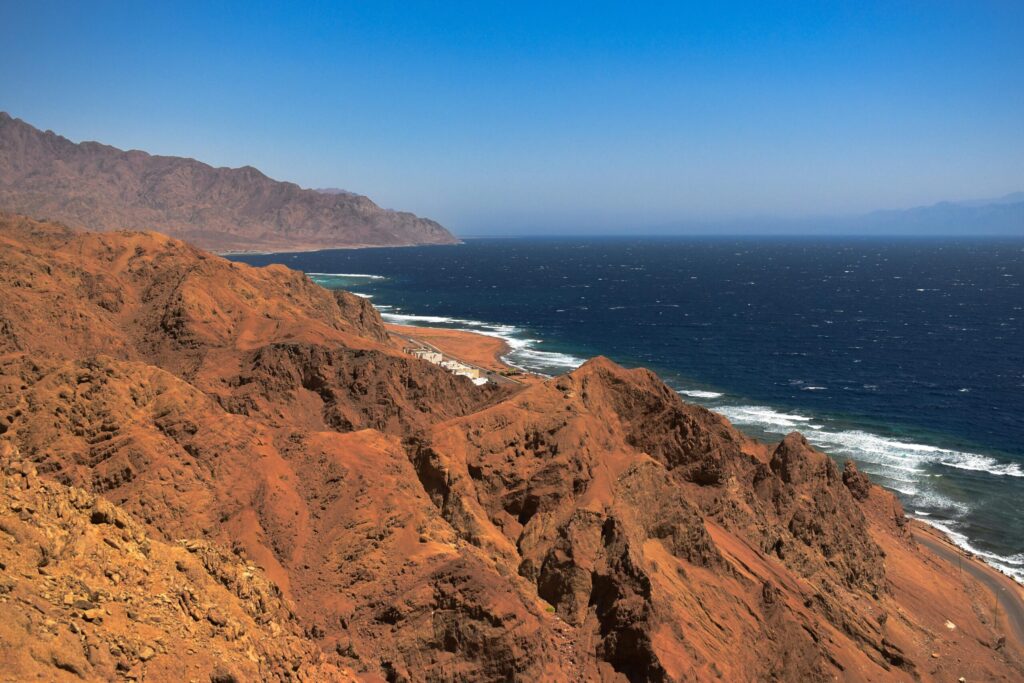
Most people agree that Ramases (where the Exodus occured) is in the eastern section of the Nile delta. Perhaps modern-day Qantir. But that’s where our common ground ends, as opinions become as divided as the Red Sea itself.
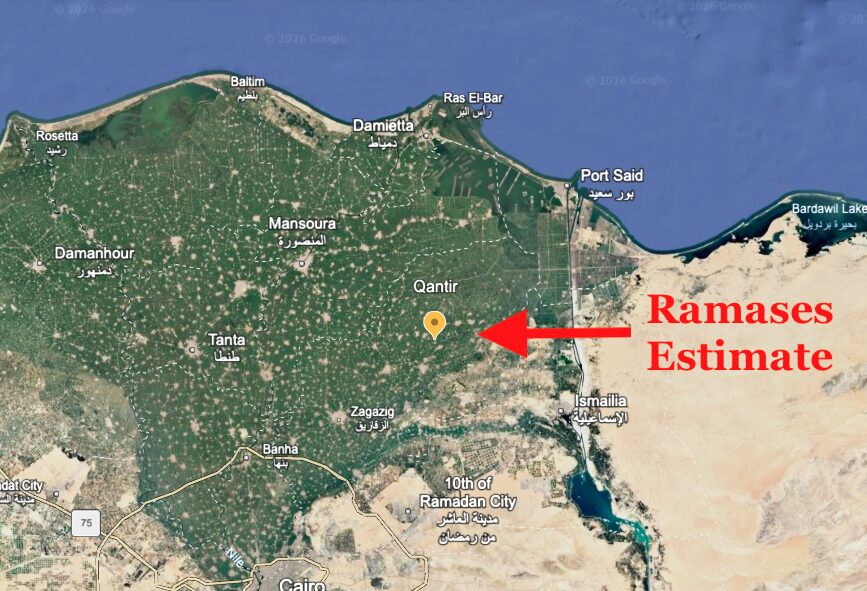
Some say that the sea crossing occurred in the Gulf of Aqaba, leading to a Mount Sinai location within Saudi Arabia. While others believe it was much closer to Ramases, in the Gulf of Suez, leading to a Mount Sinai location within the Sinai Peninsula.
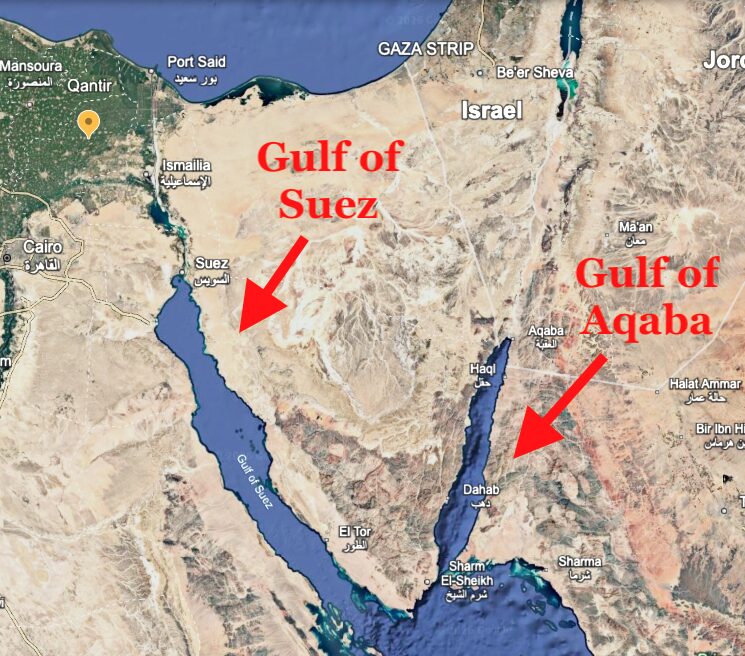
Oh boy. Well, unfortunately, one of them is wrong. And I think we can find out which one that is by going back to what we do agree on. Where it began.
But I’m going to make a slight tweak. Don’t get mad. Because even though they departed from Qantir, which I’ll be using as Ramases, they were dwelling in the best part of the land. And that was Goshen.
Exodus 47:6 — The land of Mitsrayim is before you. Settle your father and brothers in the best of the land, let them dwell in the land of Goshen. And if you know of capable men among them, then make them chief herdsmen over my livestock. (The Scriptures)
We’re given several clues throughout scripture that they were living near the river, and my guess is that they were on east side of it, and not on the west, like Qantir. Because when you look from above, you can see this section of the river is just east of Qantir. Only a few kilometers away.
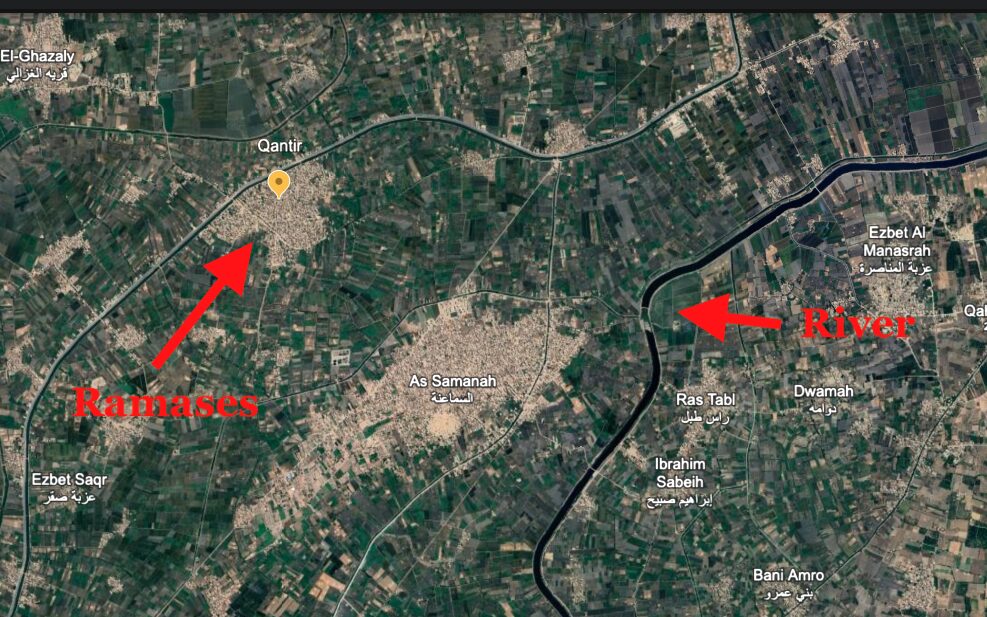
If Goshen was on the opposite side, east of the river, that would make for a smooth, clean getaway during the Exodus. Makes sense, right? I think so. Well, check this out. According to Google Earth, just east of this branch of the Nile, and less than 5 km from the center of Qantir, is a town called Ibrahim Sabeih.
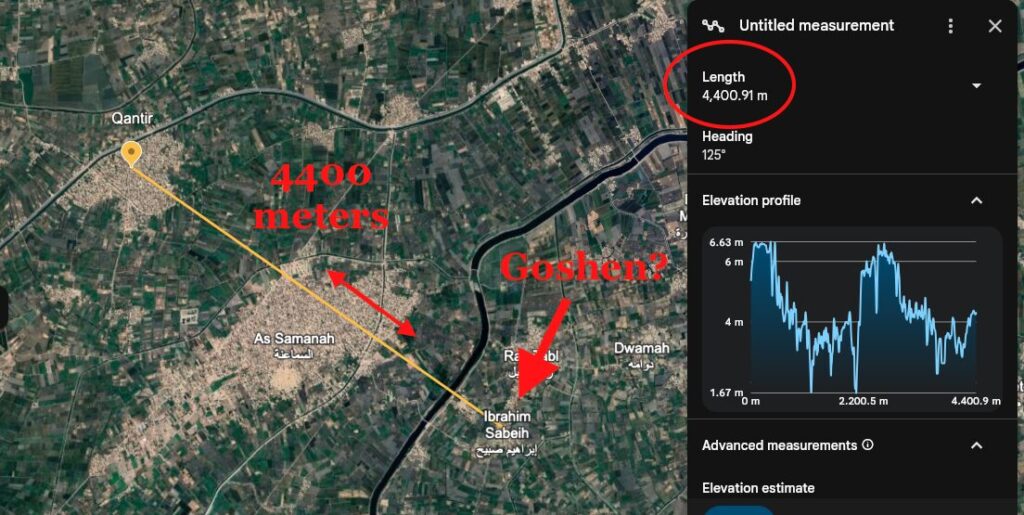
Ibrahim, if you can’t tell, (1) is Arabic for Abraham. And Sabeih, appears to come from the Arabic word, Sabih, (2) which can mean ‘handsome,’ ‘bright,’ ‘charming,’ or ‘white color.’ Now, what are the odds that there’s a town with the name of ‘Abraham,’ right where the children of Abraham may have been dwelling? Forgive me if I’m wrong, but I’m going to go out on a limb and say that this was Goshen, and use it for my starting point. And if it wasn’t exactly here, it was probably very close. So the difference should be minimal.
As for the Red Sea, I’m going to examine the Gulf of Aqaba first, leading into Saudi Arabia, to see if this could lead us to Mount Sinai.
There’s two main options for an Exodus route to Saudi Arabia…
- Moving across the center of the Sinai Peninsula, north of the mountains, before crossing the Gulf of Aqaba (about half to two-thirds of the way up).
- Bordering the Gulf of Suez to the southern tip of the peninsula, before crossing at the bottom of the Gulf of Aqaba, along the Straits of Tiran.
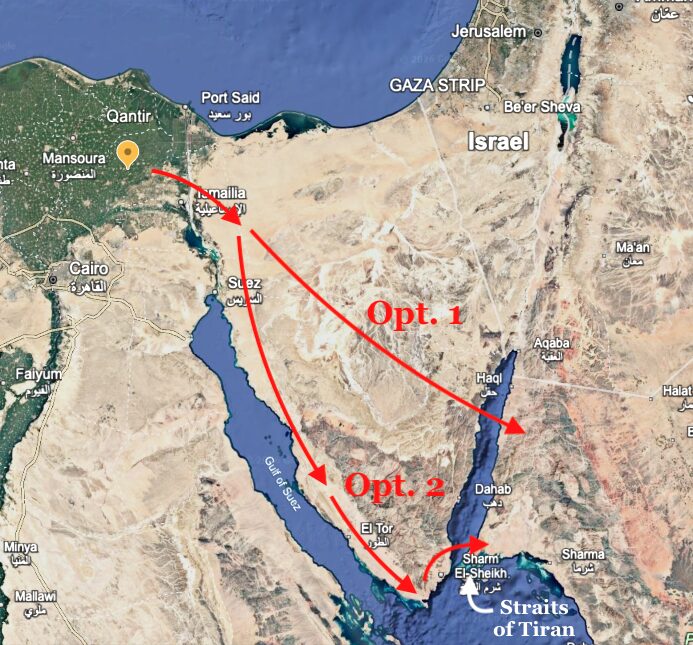
The distance for the first route option is about 360 kilometers, or 220 miles; while the second route option is about 470 kilometers, or 290 miles.
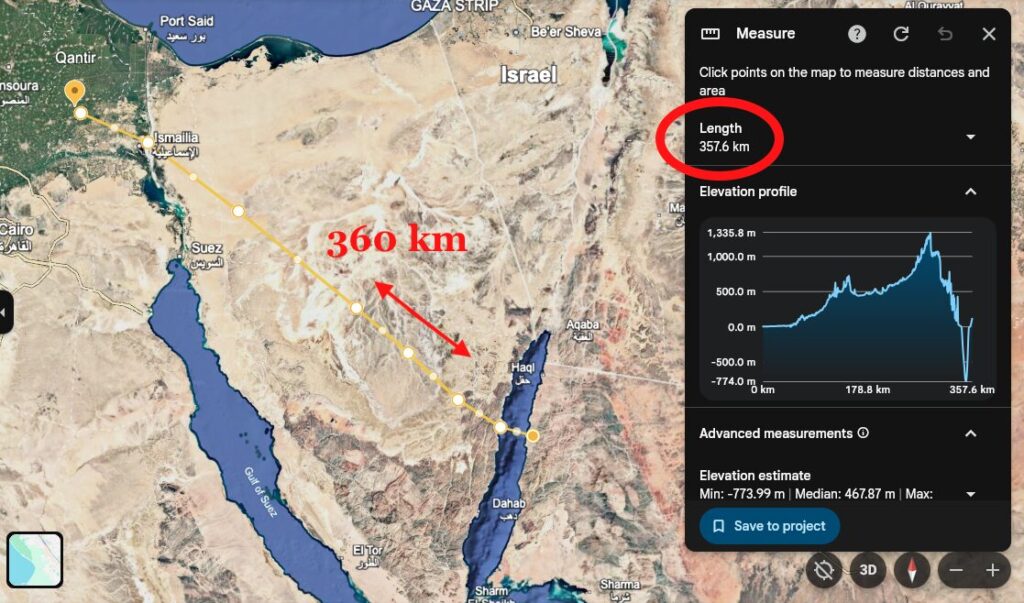
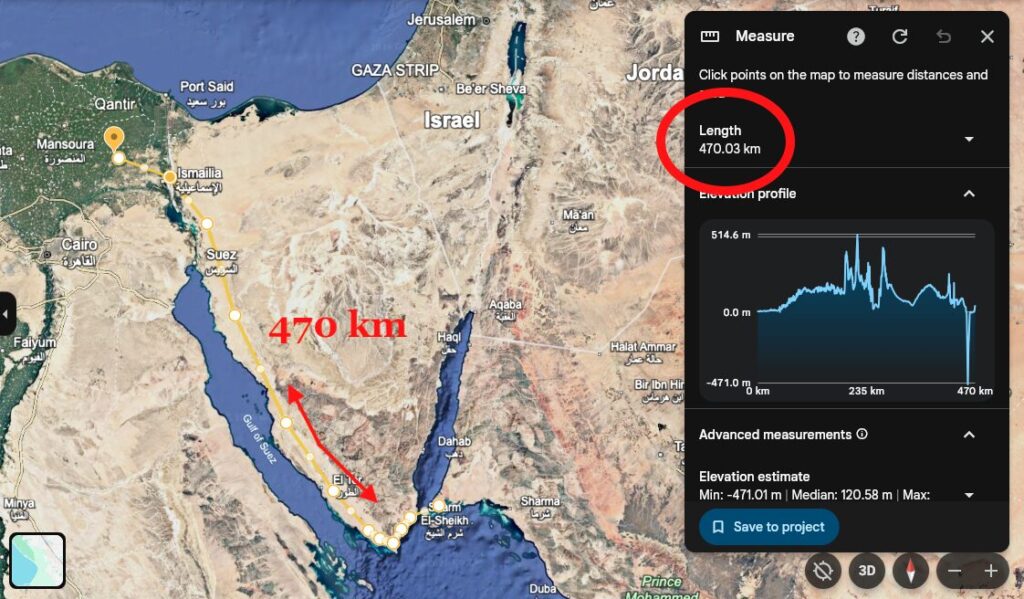
If that seems like a long distance, it’s because it is. Now sure, over the course of 40 years, the children of Israel walked much, much further on their way to the Promise Land. But the first part, from Goshen to the other side of the Red Sea, took how long again..?
23 days.
Which means, for these routes to be correct, they would have walked between 15.5-20.5 kilometers a day, or about 10-13 miles.
That’s a lot of walking. Between both of these routes, that’s an average of about 11.5 miles a day, for 23 days in a row. And let’s not forget the situation they were in…
Exodus 12:37-38 — 37 And the children of Yisra’ĕl set out from Ra‛meses to Sukkoth, about six hundred thousand men on foot, besides the little ones. 38 And a mixed multitude went up with them too, also flocks and herds, very much livestock. (The Scriptures)
Just to reiterate, that’s 11.5 miles a day for 600,000 men, not including women, or children, or the mixed multitude that went with them. 11.5 miles a day, in the desert, on foot no less, with flocks, herds, and a whole lot of livestock.
I’m sorry friends, this is where I get off the train to Arabia. Now yes, make no mistake, with Yah all things are possible. But is this probable? If they were all riding horses, maybe; but Exodus (12:37) says they were on foot when they left, and other parts of scripture seem to indicate that they were walking for 40 years.
Deuteronomy 2:7 — For יהוה your Elohim has blessed you in all the work of your hand. He has known your wandering through this great wilderness. These forty years יהוה your Elohim has been with you, you have not lacked any matter. (The Scriptures)
Joshua 5:6a — For the children of Yisra’ĕl walked forty years in the wilderness… (The Scriptures)
And because they were walking (wandering) for 40 years, that’s why it was so noteworthy that their sandals remained intact all that time.
Deuteronomy 29:5 — And I have led you forty years in the wilderness. Your garments have not worn out on you, and your sandals have not worn out on your feet. (The Scriptures)
One more scripture, then I’ll stop horsin’ around…
Deuteronomy 25:17-18 — 17 Remember what Amalĕq did to you on the way as you were coming out of Mitsrayim, 18 how he met you on the way and attacked your back, all the feeble ones in your rear, when you were tired and weary. And he did not fear Elohim. (The Scriptures)
More often than not, when someone is tired and weary, it’s because they’ve been walking on foot, not riding horses. So I don’t think we can add horses to the mix, and I really don’t think they were walking 11.5 miles a day in the desert for 3 weeks straight.
And actually, (3) some people believe they reached the Red Sea in 17 days, which would make it closer to 15 miles a day. Then there’s Josephus, who said it took the Israelites 3 days (!) to reach the Red Sea. I’ll let you do the math on that one.
The Antiquities of the Jews 2.15.1a — So the Hebrews went out of Egypt, while the Egyptians wept, and repented that they had treated them so hardly.—Now they took their journey by Letopolis, a place at that time deserted, but where Babylon was built afterwards, when Cambyses laid Egypt waste: but as they went away hastily, on the third day they came to a place called Beelzephon, on the Red Sea…
I don’t believe either of those timeframes are accurate, myself, as I’ll be sticking with the 23-day option (sorry, Josephus). But, I just wanted you to see that any way you slice it, Arabia doesn’t look good.
Though thankfully, there is an alternative: that the Red Sea crossing was in the Gulf of Suez, not Aqaba, and that Mount Sinai is somewhere within the Sinai Peninsula, and not Saudi Arabia.
But wait a minute! I hear you say. Doesn’t Paul tell us that Mount Sinai is in Arabia? That’s true, he does…
So from here on, I’m going with the numbers. I believe they’re telling us that Mount Sinai is within the Sinai Peninsula, not Saudi Arabia; and the way they entered the land — was through the Gulf of Suez.
Part III: The Red Sea and 153
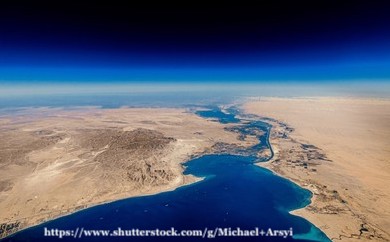
It’s not enough for us to simply rule out the Gulf of Aqaba because it’s too far away, we also want to know what makes the Gulf of Suez such an intriguing option. And, we also want to know how far they traveled in the first 22-23 days, so we can make a reasonable guess as to how far they traveled the final 27 days to Mount Sinai.
In short, the Red Sea is pretty important.
There’s a few clues I’ll be focusing on to find a potential Exodus route…
- They were not led ‘by way of the land of the Philistines, though that was nearer’ (Exodus 13:17). Which means, they steered clear of the Mediterranean coastline, since the Philistines were inhabiting the Gaza Strip region at that time. So right away we know that they didn’t go north, but rather east. Perhaps even southeast, initially, before turning fully south.
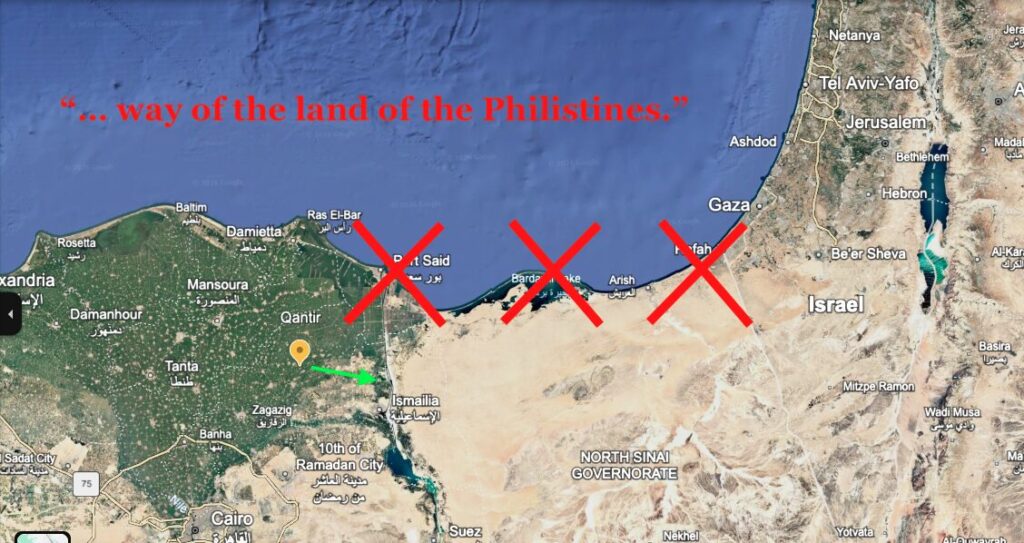
- After camping in Etham, they ‘turned back’ (Numbers 33:7). In Hebrew, the word for ‘turned back’ is שוב (shoob), which could also mean ‘return.’ On the surface, that sounds like they did a complete 180, but that would mean they were originally heading north, which would contradict the scripture about them not going ‘the way of the land of the Philistines.’ However, the Greek Septuagint says, ‘let them turn,’ not turn back, just turn, which seems to be a better fit (Exodus 14:2). They were heading toward the sun, then turned southward.
As for Etham, it’s in the “edge of the wilderness” (Numbers 33:6). From this, it seems that they were either about to exit, or had already left, the fertile Nile Delta region. That’s why I feel a good candidate for Etham would be somewhere around modern-day Ismailia, where the wilderness and the northern line of the Gulf of Suez meet. Anything further east would no longer be the ‘edge’ of the wilderness, but the actual wilderness. Also, this spot would have allowed them to distance themselves from the Mediterranean, while still heading eastward. I think it works.
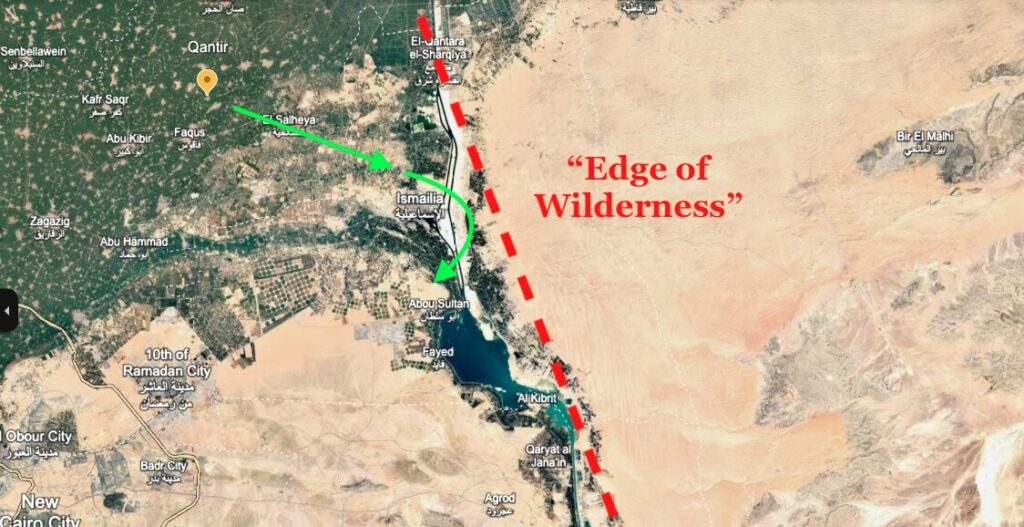
- Then, they continued south toward the western side of the Gulf of Suez.
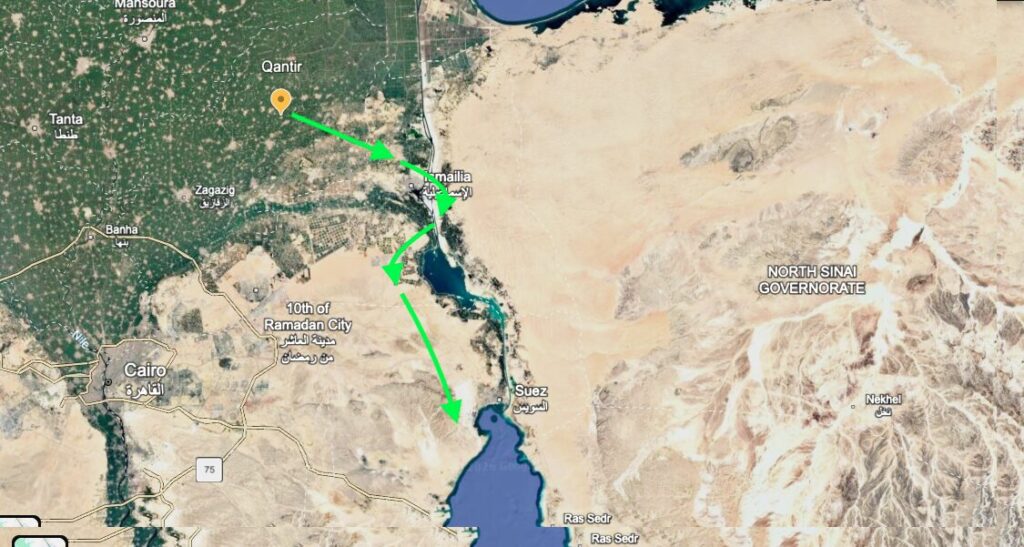
- And from here, they camped by the Red Sea. We’re told that the place they encamped, Pi Hahiroth, was a spot where Pharaoh would say to himself, they’ve been “entangled in the land” (Ex. 14:3). Also, in Hebrew, Pi Hahiroth could mean ‘the mouth of freedom.’ Pi comes from Pah (פה), meaning ‘mouth,’ and חרות (kharoth) means ‘freedom.’ Wouldn’t that be appropriate?
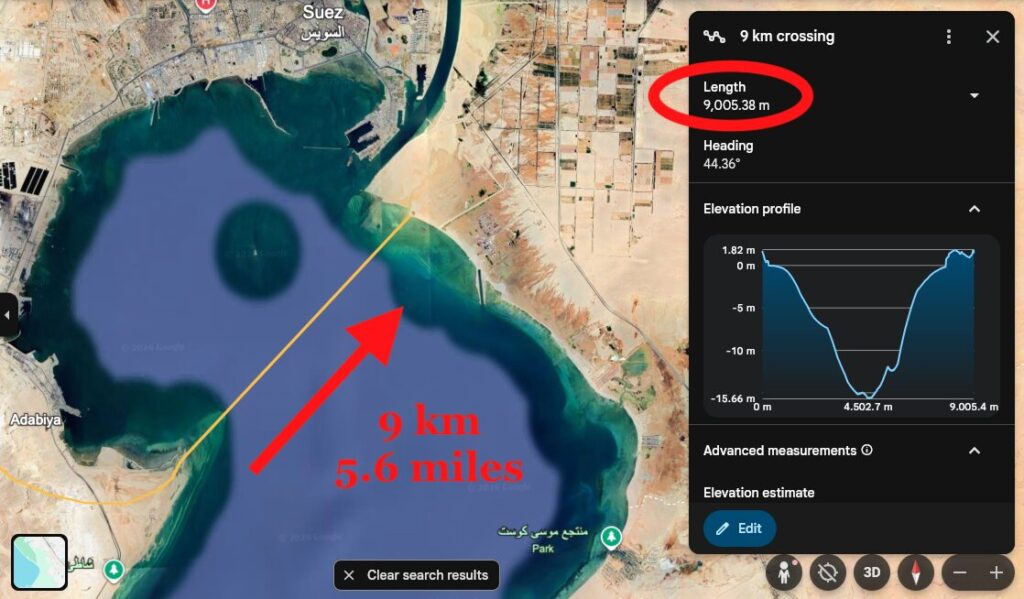
So where is Pi Hahiroth? When looking at the Gulf of Suez from above, there’s one spot that immediately sticks out to me. It’s as if a pocket of land, or perhaps even, a mouth, presses in toward the sea. It does look like a mouth, does it not?
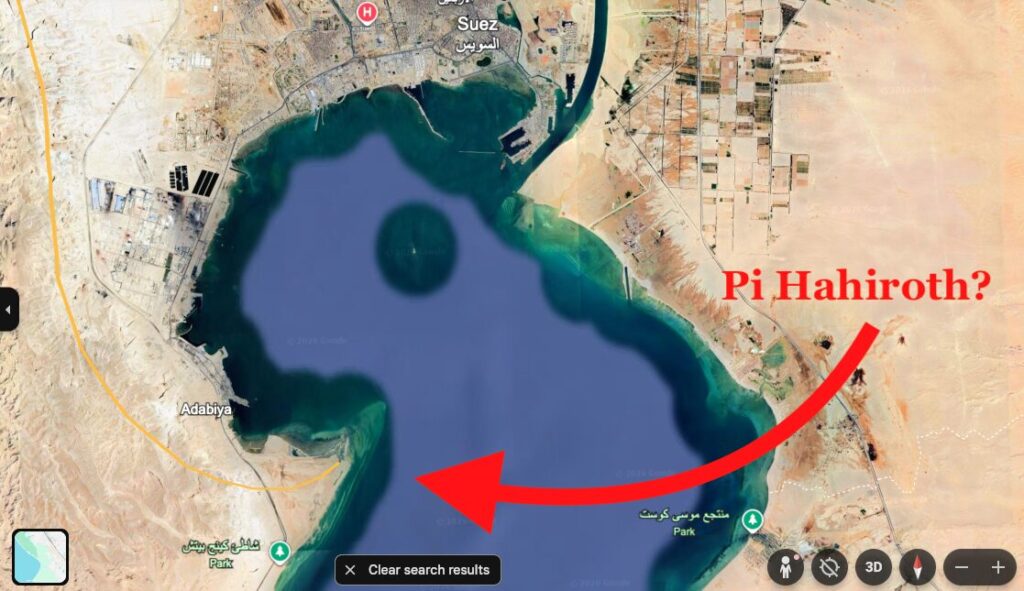
So if I were Pharaoh, and I saw all the Israelites bunched together in this press of land, I could easily see where they would appear to be trapped.
This is also one of the smallest points of the gulf. A crossing to the other side would be about 9 kilometers.
Biblical Units and the Metric System?
This is a good time for me to say: I believe there’s a connection between biblical measurements and the metric system. That’s because a biblical cubit, called an ammah (אמה), is said to be half a meter. So when you see interesting numbers match up with measurements in meters and kilometers, I believe that’s why.
So get ready…
When charting out a course from Goshen, heading east, with a slight southward bend, then turning fully south, heading down towards the Gulf of Suez, and encamping at the edge of the ‘mouth,’ the distance comes to 144 kilometers.
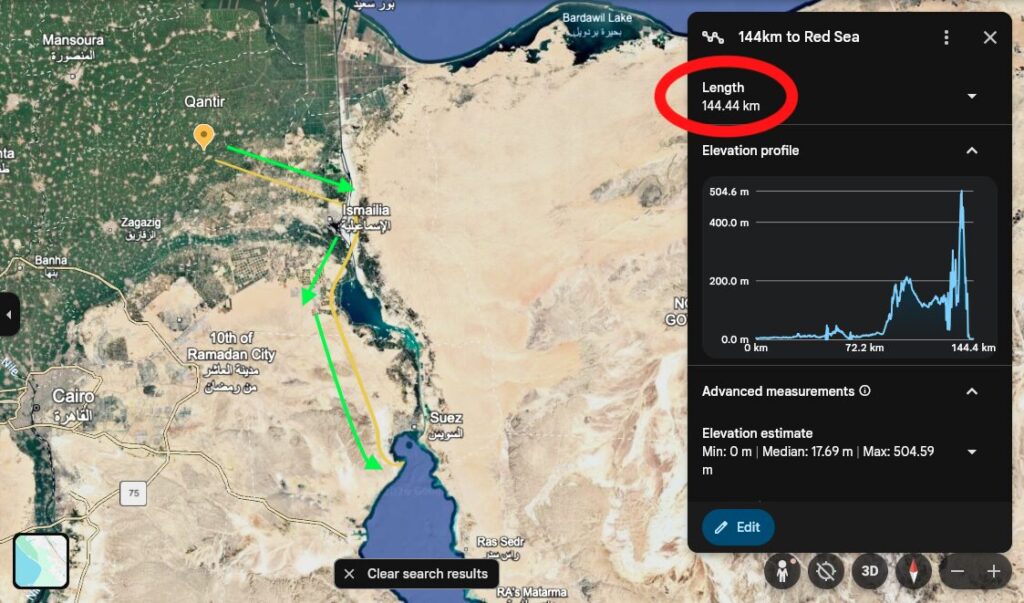
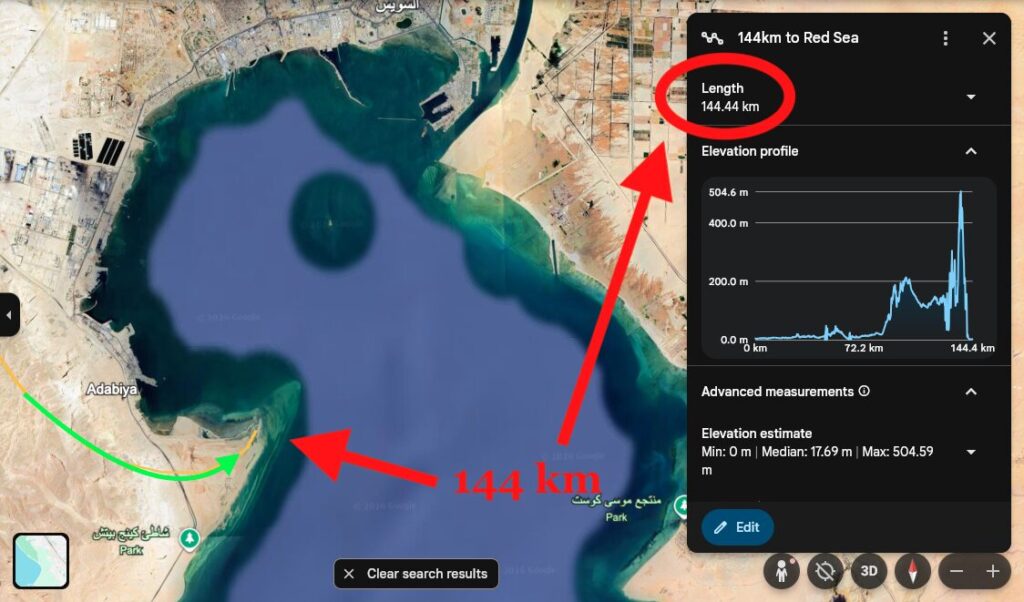
Now, how cool is that? The 12 tribes of Israel may have gone 144 kilometers to the Red Sea. Was this the earliest hint of the 144,000 to come (Revelation 7)? I wonder.
But it gets better…
If they crossed the Gulf of Suez here, where the land seems as though its pointing to the other side, and where it’s also the shortest distance across, at 9 kilometers, that would mean they traveled 153 kilometers to the opposite shore of the Red Sea.
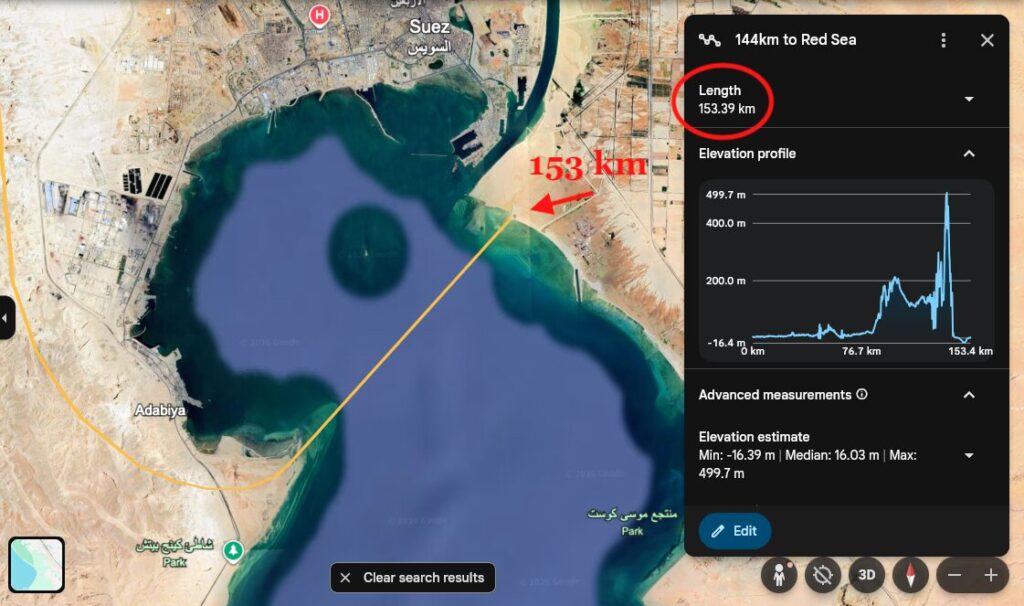
153.
Incase you don’t know why that number is important, John 21 tells us of a time when a large catch of fish was brought to shore, without the net breaking. And the number of fish in the net — was 153.
John 21:11 — Shim‛on Kĕpha went up and dragged the net to land, filled with one hundred and fifty-three big fishes. And though there were so many, the net was not broken. (The Scriptures)
Is there a connection between the 153 fish that were brought to shore, and the 153 kilometers the children of Israel traveled before arriving on the shore of the Red Sea? Again, I wonder.
While the number 153 could have many biblical meanings, I think this might be one of them.
And don’t forget, when did they arrive at the Wilderness of Sinai…?
- The 15th of the 3rd month.
- 15/3.
- Or, 153 yet again.
So because of that, and all the other reasons I mentioned, I believe this is the spot where the children of Israel crossed the Red Sea, and then, continued their journey toward Sinai.
- By the way, 144 and 153 are the certainly the highlight numbers; but did you notice the 44’s as well? Ibrahim Sabeih (Goshen) is 4400 meters from Qantir (Ramases). Also, where the children of Israel may have crossed the Red Sea, it had a directional heading of 44 degrees. Coincidence, or something more? I’ll let you decide.
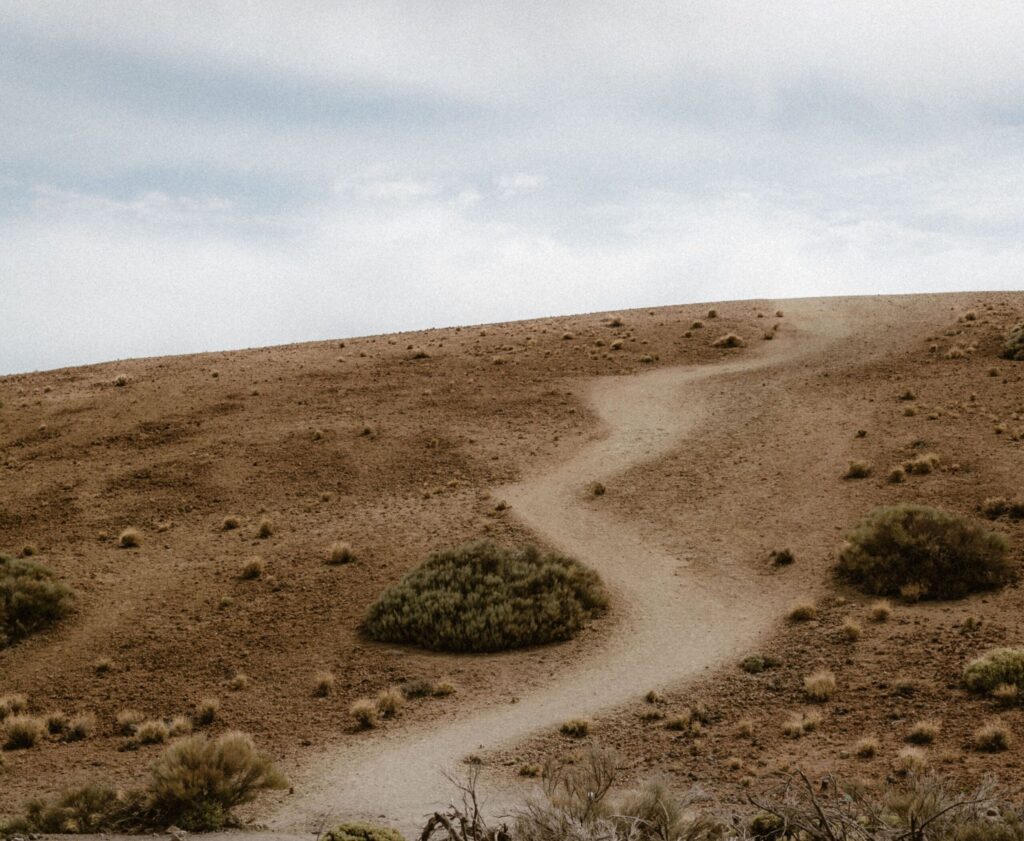
Part IV: On The Road Again…
Now that we have a possible distance for the first 22 and 23 days, we can crunch some numbers and take a guess as to how far they traveled for the final 27 days.
We have two options, both yielding similar results…
First, they traveled 144 kilometers in 22 days to the Red Sea. That would be an average of 6.54 kilometers per day.
- 144 km / 22 days = 6.54 km/day
Second, they traveled 153 kilometers in 23 days, to the opposite shore of the Red Sea, for an average of 6.65 kilometers per day.
- 153 km / 23 days = 6.65 km/day
I’m going to speculate that whatever they averaged from Goshen to (or through) the Red Sea, they also averaged from the Red Sea to Sinai. Days when they were without water may have been less, but overall, I think it balanced out; because our Father is very consistent with numbers.
Now, we multiply each of these options by 50, for 50 days of travel.
- 6.54 km/day x 50 days = 327 total km
- 6.65 km/day x 50 days = 332.5 total km
So we have somewhere between 327 and about 333 kilometers. I could pick one or the other. But you know what? I’m going to go right down the middle, and say that they traveled 330 kilometers in all.
Here’s why…
Once they reached the Wilderness of Sinai on 3/15, they kicked off their sandals and stayed a while; because they didn’t move again for another 11 months. Or, 11 months and 5 days, to be exact — the 20th day of the 2nd month.
Numbers 10:11-12 — 11 And it came to be on the twentieth day of the second new moon, in the second year, that the cloud was taken up from above the Dwelling Place of the Witness. 12 And the children of Yisra’ĕl departed, setting out from the Wilderness of Sinai. And the cloud dwelt on it in the Wilderness of Paran. (The Scriptures)
For these particular lunar months, I believe that comes to 330 days.
- 3/15 – 3/29 = 15 days
- 4/1 – 4/30 = 30 days
- 5/1 – 5/29 = 29 days
- 6/1 – 6/30 = 30 days
- 7/1 – 7/29 = 29 days
- 8/1 – 8/30 = 30 days
- 9/1 – 9/29 = 29 days
- 10/1 – 10/30 = 30 days
- 11/1 – 11/29 = 29 days
- 12/1 – 12/30 = 30 days
- 1/1 – 1/29 = 29 days
- 2/1 – 2/20 = 20 days
- = 330 days in all
With that in mind, wouldn’t it be perfect if they traveled 330 kilometers, to a place they would stay for 330 days? I think so. Which means after the Red Sea, over the final 27 days of their 50-day hike, they traveled 177 kilometers to Sinai.
- Goshen to the Red Sea — 144 km
- Red Sea crossing — 9 km
- Red Sea to Sinai — 177 km
- = 330 km in all
Alright, I think that’s enough buildup on my part. It’s time for us to find Mount Sinai. Because now we have a potential distance. It’s just a matter of seeing how far will 177 kilometers from the Red Sea take us.
Let’s find out.
The Final 177.
We know that after the sea crossing they were in the wilderness for 3 days (Numbers 33:8), and, that they were going south; because they encamped by the Red Sea once again, in 6 days (Numbers 33:10). Or, 6 days according to my estimates.
So what I did was bring their route slightly inland for 5 days, then pulled it back toward the sea on the 6th, with my (roughly) 6.5 km/day average.
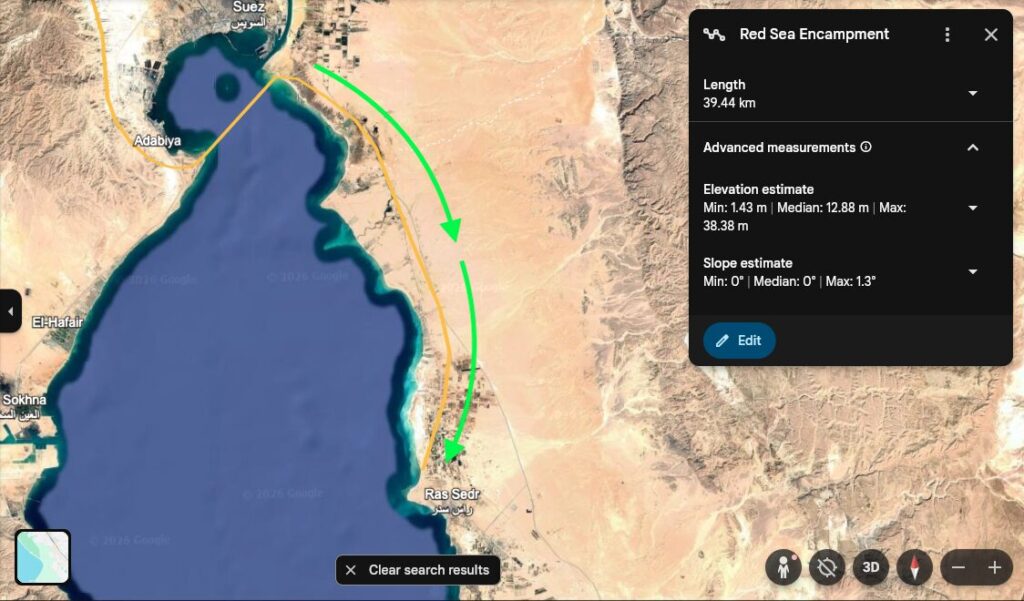
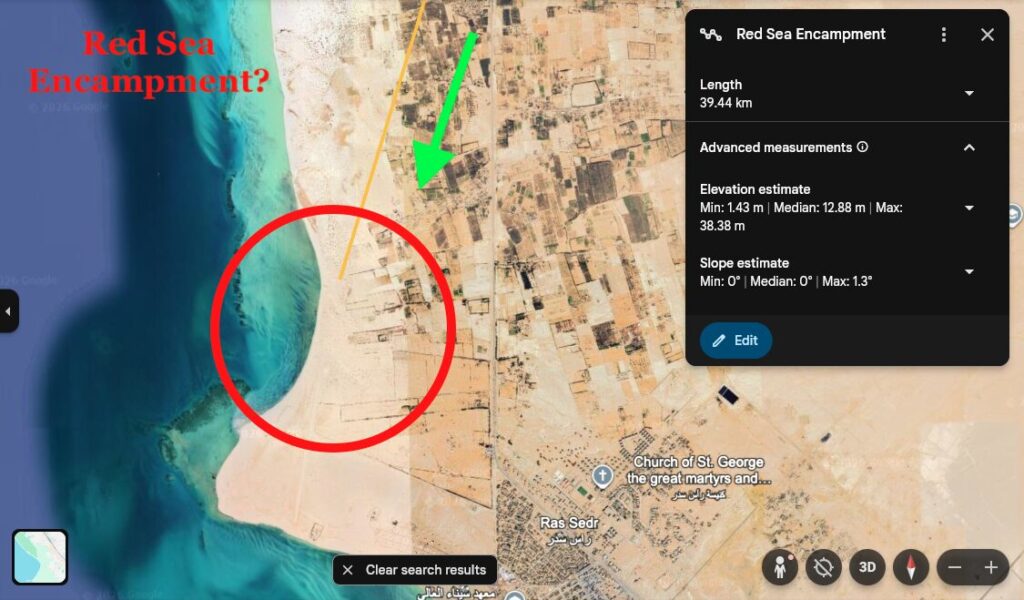
From here to Sinai, the book of Numbers never mentions them turning, like it did before the Red Sea. So I think it’s safe to say that they continued their journey southward.
Also, once they do reach Mount Sinai, they’re told to stay at the base of the mountain, and not to even touch the border, or they’d be put to death.
Exodus 19:12 — And you shall make a border for the people all around, saying, ‘Take heed to yourselves that you do not go up to the mountain or touch the border of it. Whoever touches the mountain shall certainly be put to death. (The Scriptures)
Because of that, I think they more than likely remained on the western side of the mountain range, as they continued their journey southward.
Now, it’s possible that they were just supposed to stay away from the peak of Sinai, and not the surrounding mountains in that range. Which means that they could have ventured into the mountains. But remember, wherever the Wilderness of Sinai is, they stayed there for almost a year. And if that’s the case, why did Moses say this?
Deuteronomy 11:10-11 — 10 For the land which you are going in to possess is not like the land of Mitsrayim from which you have come, where you sowed your seed and watered it by foot, as a vegetable garden, 11 but the land which you are passing over to possess is a land of hills and valleys, which drinks water from the rain of the heavens. (The Scriptures)
The main context of this passage is related to rain and agriculture; but unless I’m mistaken, he’s also speaking to them as if they’ve never lived in hills or valleys before. That would be strange to say if they had been living in the mountains for about year. And not just any year, arguably their most important year in the wilderness.
I think this is a clue that they stayed where the land was level, which means that they remained west of the mountains as they continued heading south. And the route I’ve chosen reflects that.
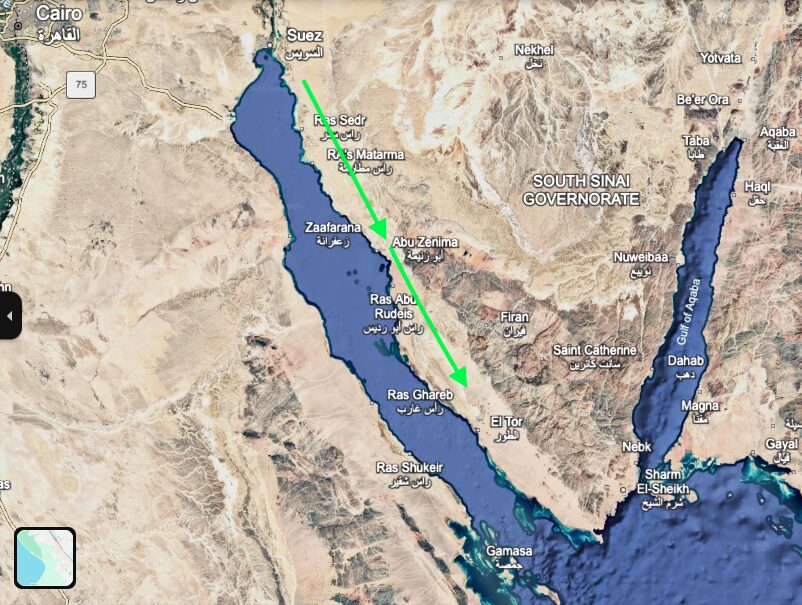
I’ve found a path that keeps them west of the mountains, while also keeping them on a straight line south, with a slight bend here or there when it makes sense. At the very end, I brought the route inland, to the edge of the mountain, since Exodus (19:2) says they camped before the mount.
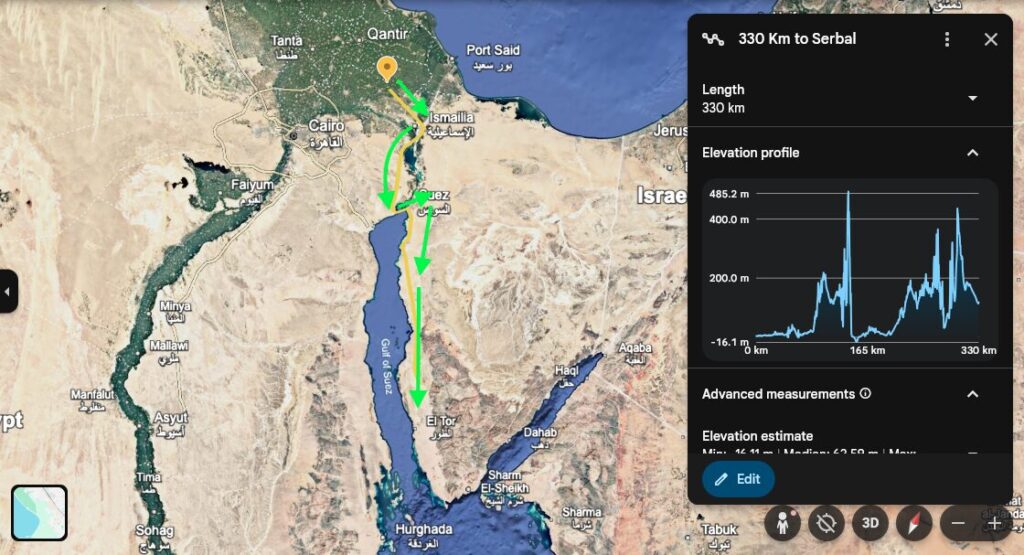
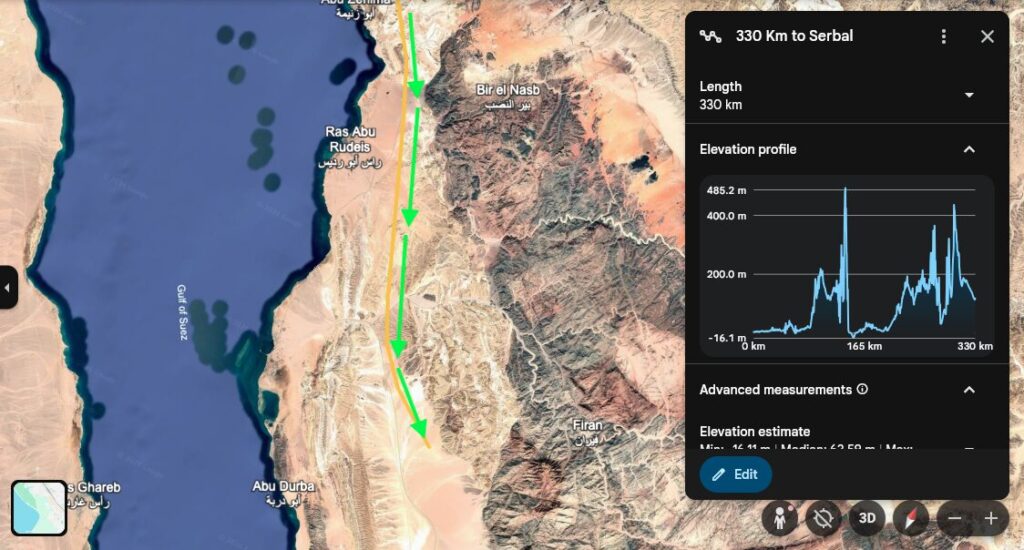
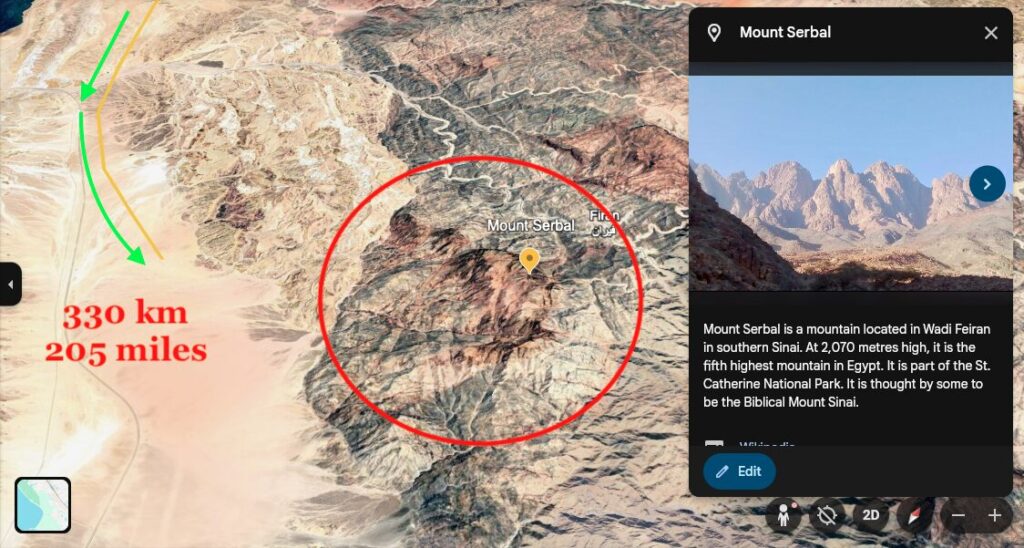
And after a 330 kilometer (205 mile) journey from Goshen, that would have put them directly in front of Mount Serbal. The mountain peak I believe to be the true Mount Sinai.
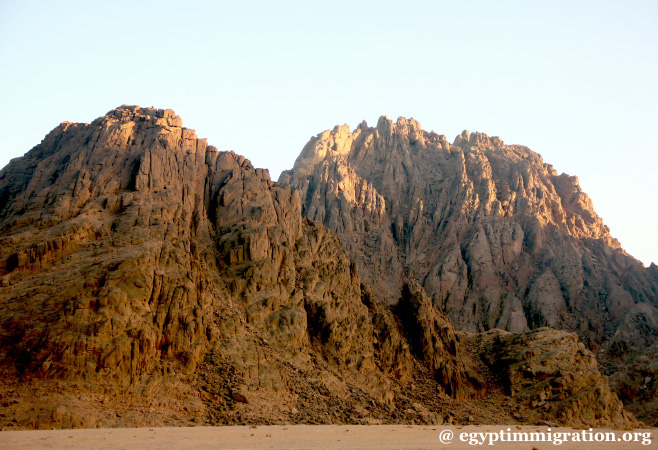
Part V: The Case for Serbal
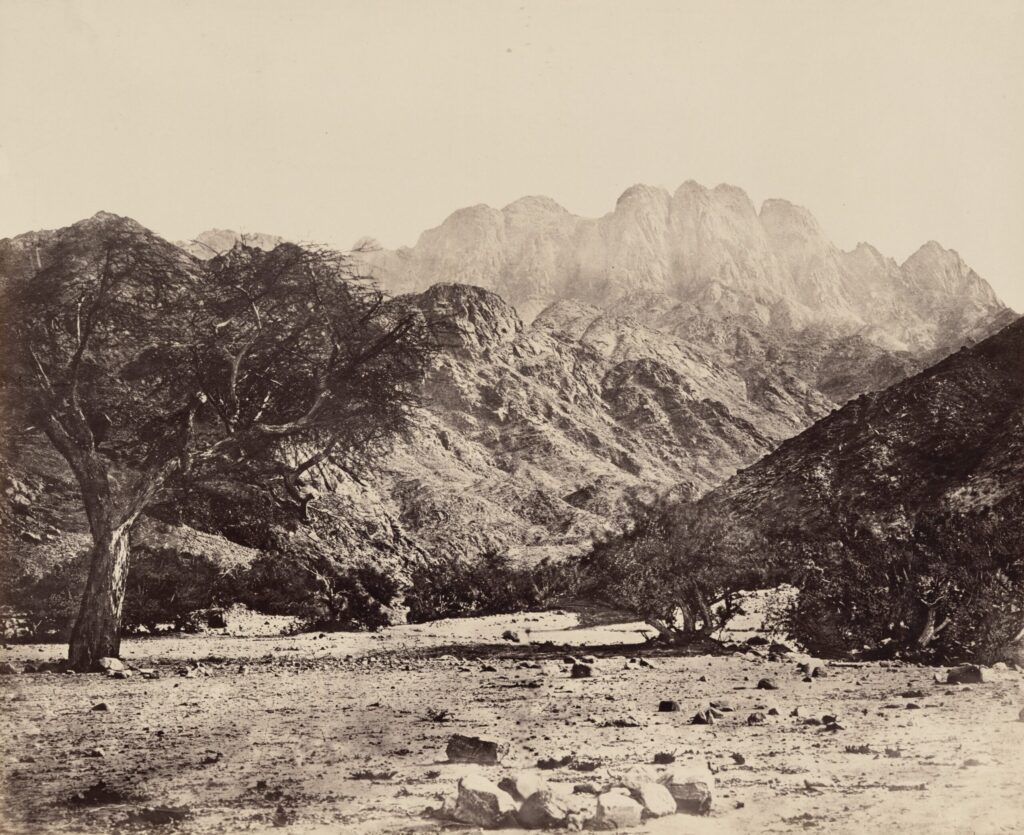
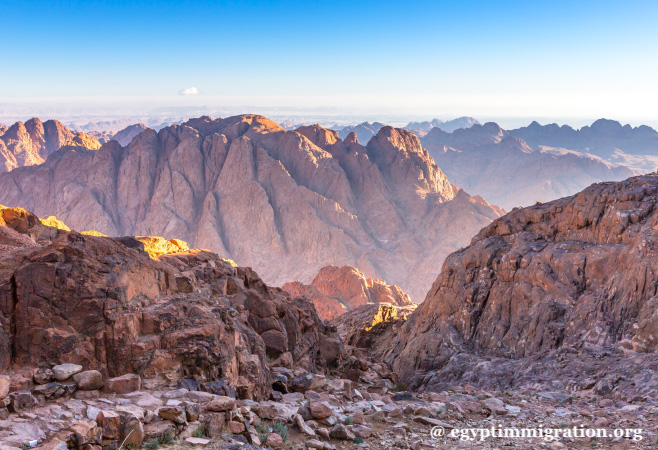
Just look at it. Isn’t it majestic? Forget about the calendar and the numbers for a moment, and just let it sink in. This may be the very peak where our Creator descended. Right here.
Though to be clear, I’m not breaking new ground by suggesting Jabal (Mount) Serbal is Mount Sinai — others have said it before me; but, Serbal is not the most popular choice on the Sinai Peninsula. That award goes to the mount that’s actually named ‘Mount Sinai.’ And it’s commonly referred to as Jabal Musa, which literally means ‘Mountain of Moses.’
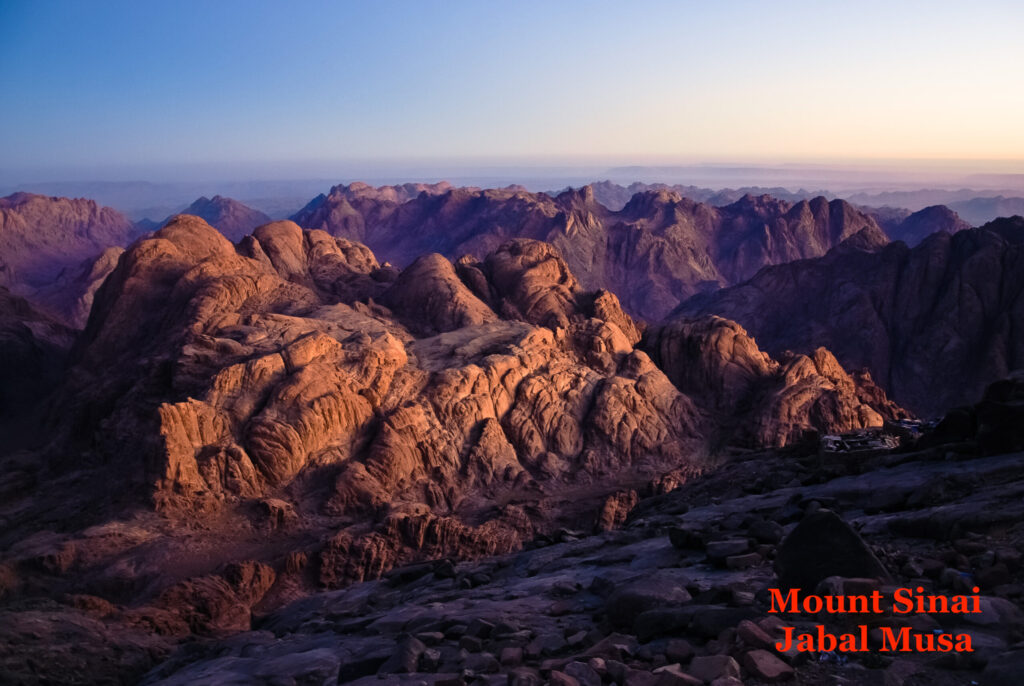
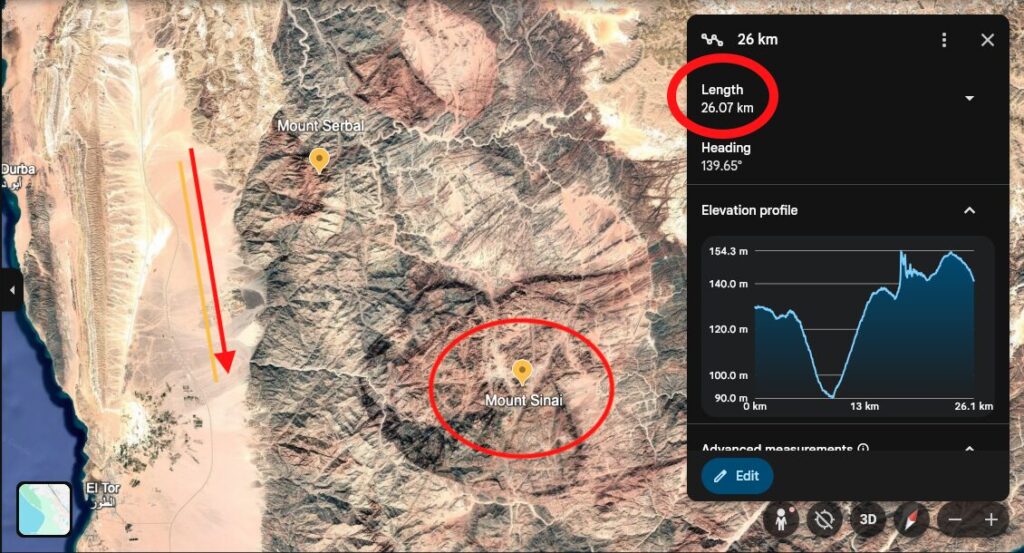
It’s quite majestic, too, I must admit. And it’s hard to oppose a mountain that’s already named ‘Sinai.’ But I’m going to try, because based on my numbers, Musa doesn’t quite add up. It’s about 26 kilometers further than Serbal, which would be about 4 more days of travel.
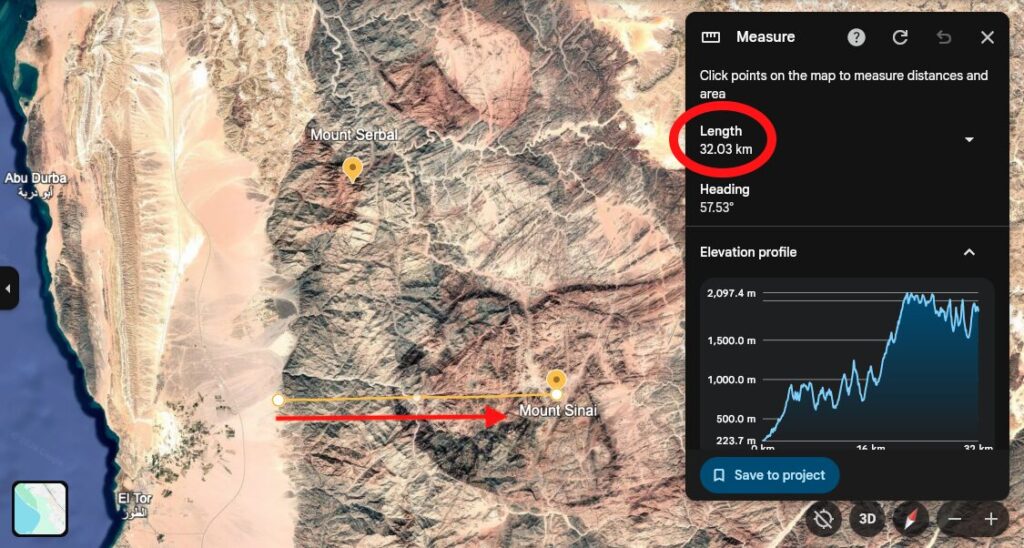
It’s also much further in, about 32 kilometers from the base of the range, where Serbal is a quarter of that. And for me, this is Jabal Musa’s biggest drawback.
After arriving at the mount (Exodus 19), Moses went up to receive instruction, then the Father called to him from the mountain. He did this twice after they arrived. While the bible doesn’t clearly say that he went the entire way up these two times, the third time — it does.
If this was Jabal Musa, Moses would have gone 32 kilometers to the top, just to be told to turn around and go back to the bottom. That’s a 64-kilometer, or a 40-mile roundtrip, up and down a mountain. That’s rough, considering he made this trip several times.
Let’s check out Serbal…
The peak of Serbal is only 8 kilometers from the base (versus the 32 of Jabal Musa), and another 3 kilometers to where the land truly flattens out.
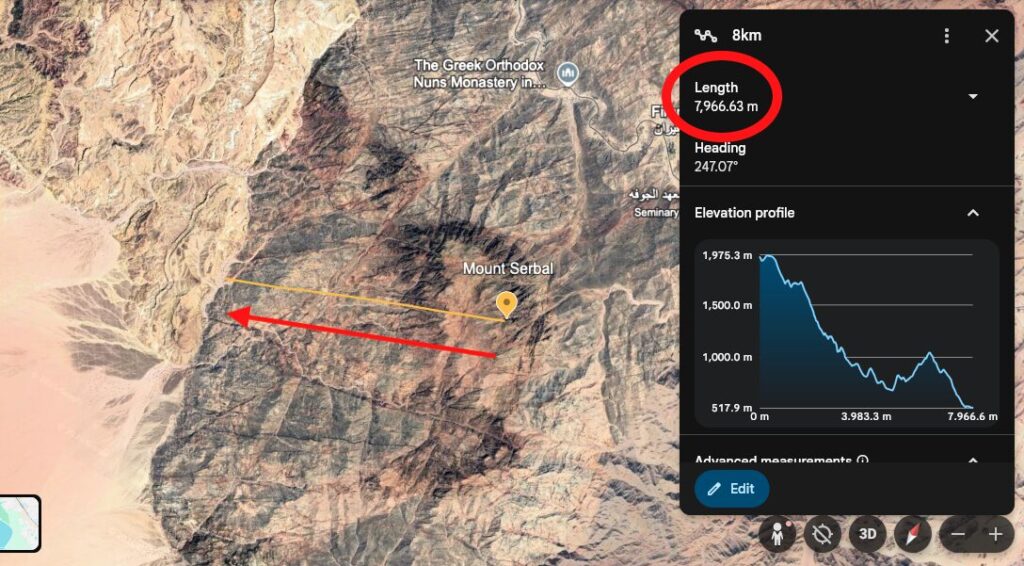
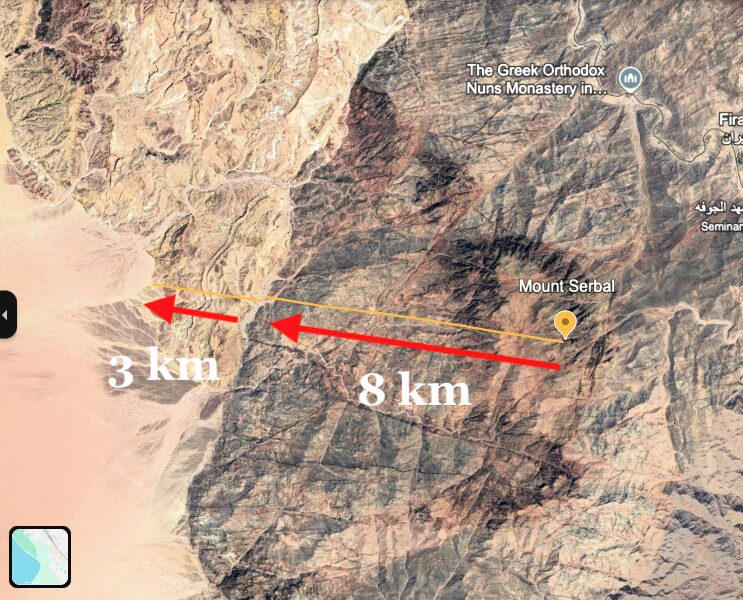
And actually, there’s a small table-like section in front of the peak, where Moses probably would have received the tablets, less than 7 kilometers from the base, and about 10 kilometers from the flat land. So the total distance is somewhere between 7-11 kilometers (4-7 miles).
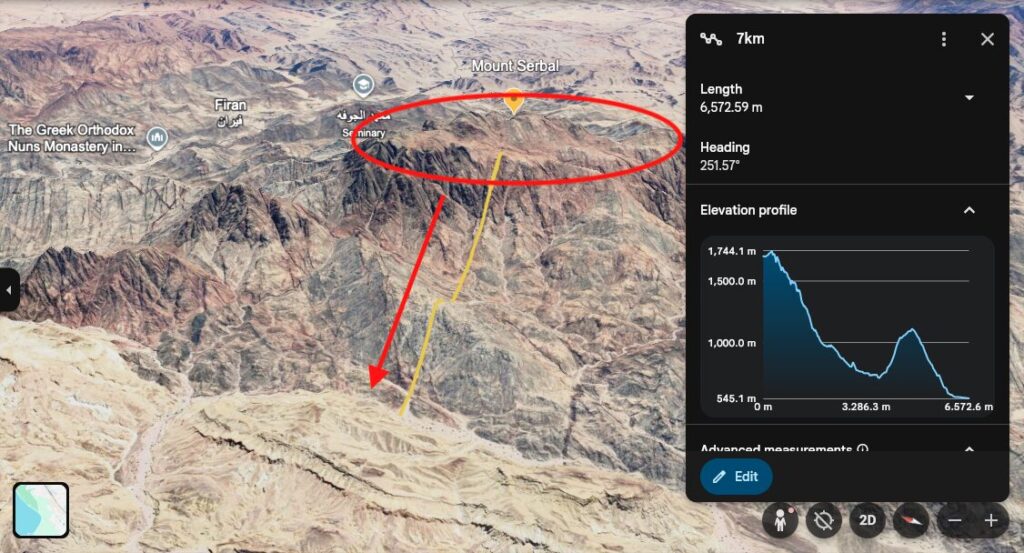
That means Serbal would have been between a 14-22 kilometer roundtrip for Moses, or about 8-14 miles to the top and back, depending on what was considered the top, and where the official border was at the bottom. Still no easy task, but much less than Musa’s 40 miles.
As for that flat-piece of land in front of Mount Serbal, it presses in toward the base, very similar to the mouth at the Red Sea, and this section is about 2.5 kilometers each way, length by width.
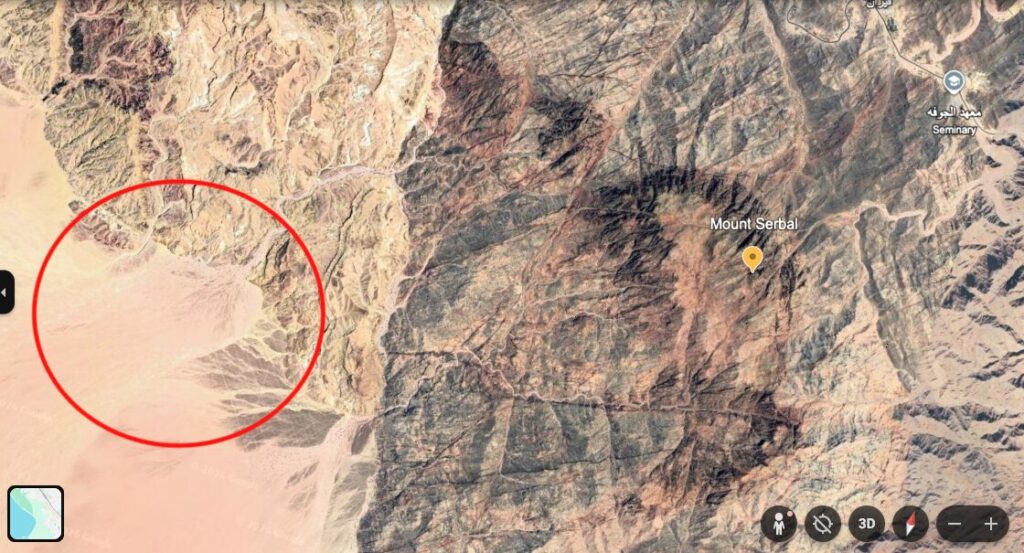
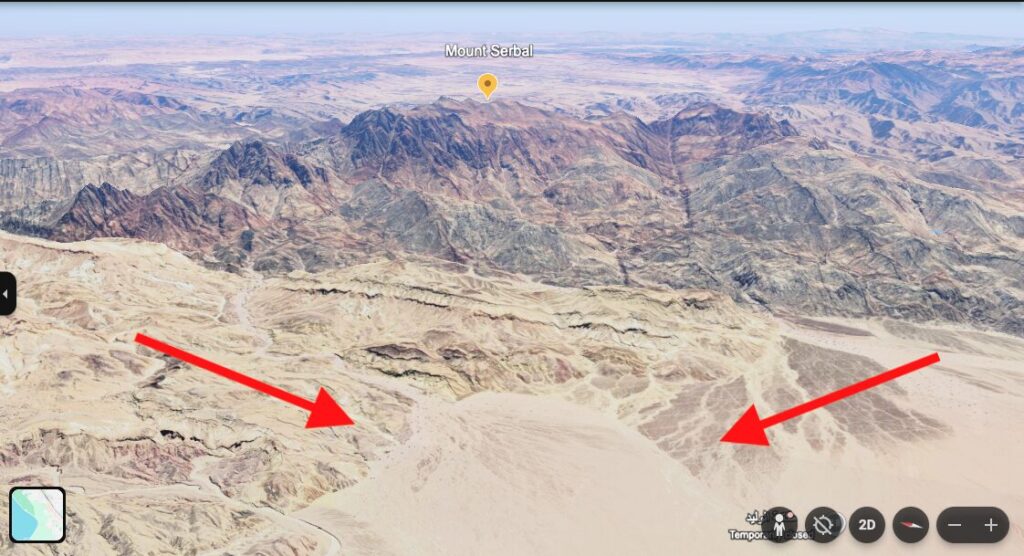
It almost seems as if it was made to be a viewing point of the peak, does it not? I think this might be where the camp stood. Because on the 3rd day, Moses brought the people out of the camp, and they stood at the foot of the mountain.
Exodus 19:16-17 — 16 And it came to be, on the third day in the morning, that there were thunders and lightnings, and a thick cloud on the mountain. And a voice of a shophar was very strong, and all the people who were in the camp trembled. 17 And Mosheh brought the people out of the camp to meet with Elohim, and they stood at the foot of the mountain. (The Scriptures)
So he brought them closer. And if I’m right, they were in front this spot to begin with. It could work.
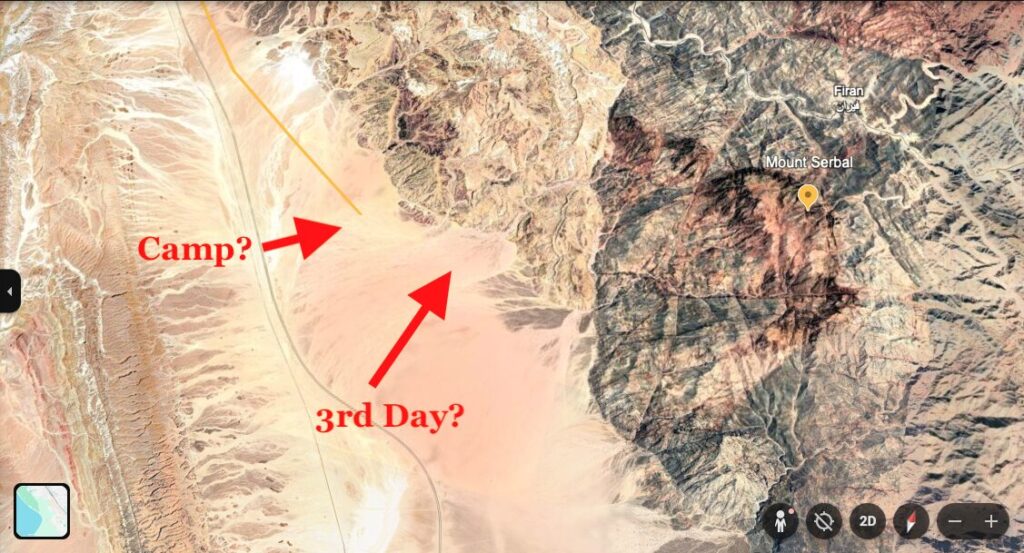
So Mount Serbal works with my 330 kilometer estimation; and, its location within the Sinai mountain range seems to fit with the details we’re given in scripture.
As for the other option, Jabal Musa, I can see why it’s a popular choice. I mean — it’s named after Moses, with a second name of ‘Mount Sinai.’ What’s not to like? And, it does appear to be in the right general area. (Which is more than Saudi Arabia can say.) But for me, the location and numbers of Mount Serbal seem to work better overall.
One More Consideration…
There’s something else about Mount Serbal that really piqued my interest. And yes, it involves the calendar. Fair warning: this gets rather technical. But it’ll be worth it…
According to the book of Jubilees, the Exodus took place in the year 2411.
If you’re interested in the timeline, check out THIS article, where I explain why I believe 2411 is an accurate date.
Now, 2411 on the Enoch calendar was the 17th year of the lunisolar cycle. That’s because the sun, moon, and stars travel in 19-year cycles, and 2411 would have been the 17th year of that cycle.
- 19-year cycle x 126 cycles = 2394 years
- Year 2394 + 17 years = Year 2411
However, because the lunar year begins in the spring, and the solar year begins in the fall (from which we get the yearly count), the lunar months are 6 months ahead. So technically, while the Exodus still occurred in the official year of 2411 (I believe), it was already 2412 on the lunar calendar. (Strange, I know.) So that would be the 18th year of the lunar portion, but still the 17th of the solar.
For more on the differences between the lunar and solar calendars, check out THIS article.
In that lunar year (2412), the 3rd lunar month, when they arrived at Sinai, would have been the 207th recorded month of that cycle.
207.
- 17 years x 12 months = 204 months
- 204 months + 3 lunar months = 207th month
- And in case you’re wondering, the 13th lunar month isn’t calculated like the other 12. Similar to how days 365-366 aren’t calculated on the Enoch solar calendar. They still exist, but aren’t recorded. That’s why all my calculations are done using a 12-month year.
I said it’d get technical, didn’t I? But the main takeaway is this: they arrived in the 207th lunar month of that cycle. I told you we’d see 27 again.
Now check this out…
Remember that small pocket of land in front of Mount Serbal, where I believe the Israelites may have gathered on the 3rd day? Well, right in the middle of this section, the elevation is 207 meters. Yep. 207.
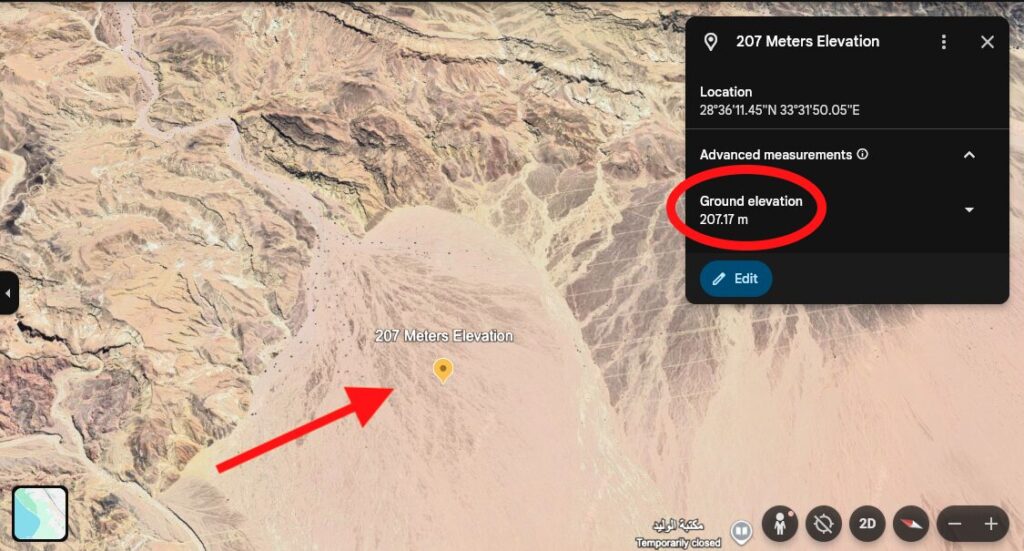
And the connections only goes up from there; (6) because the height of Mount Serbal is said to be 2070 meters. Again, 207 pops up.
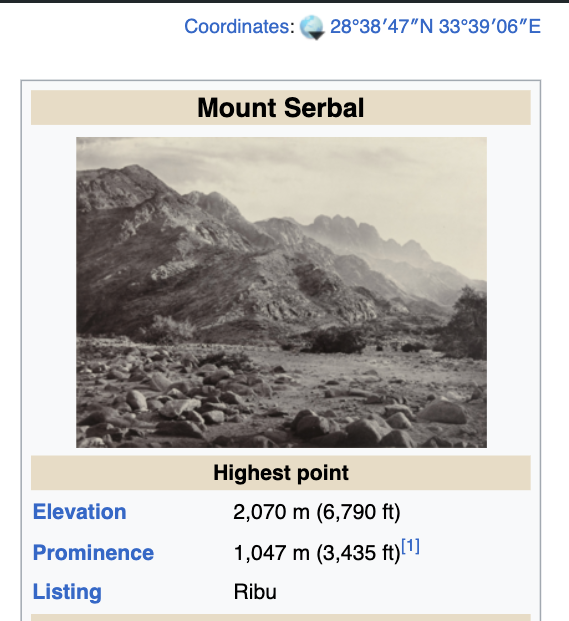
If that isn’t wild enough, remember what day they arrived at Sinai? The 15th of the 3rd month. 153. Well, according to a website called PeakVisor (7), the prominence of Mount Serbal is 1053 meters.
153.
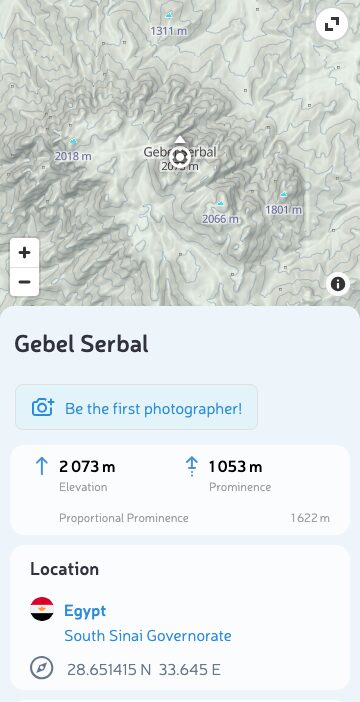
But… full disclosure, Wikipedia says that the prominence is 1047 meters, which is 6 meters less. So there’s a slight discrepancy. And they aren’t in complete agreement on the height, either — 3 meters apart.
However, out of all the repeating numbers we’ve seen — 153, and the variations of 27, or 207, can you blame me for going with PeakVisor? A prominence of 1053 meters just seems… so… perfect!
… I’m a nerd. What can I say?
There’s actually more connections to the number 207, as well as the length of their stay, 11 months and 5 days (115), but I’m going to save those for a video in my ‘Watchers Series.’ Let me just say this: Mount Sinai is the place where good triumphs over evil. Stay tuned, and Subscribe for new updates.
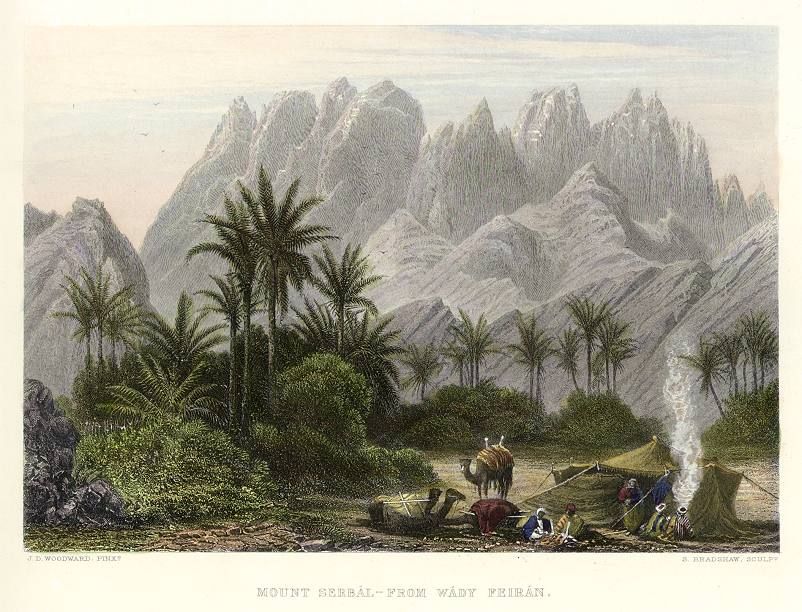
So between people like Ludwig making those connections, and me presenting my case with numbers, perhaps you’ll consider this to be the true location as well.
Remember. The Father’s ways are perfect. When there’s connections that perfectly align between the calendar, measurements, and the Exodus account as a whole, it makes me look at Mount Serbal and ask, “Could it be? Is that Mount Sinai?” — To me, it sure seems like it.
Thank you so much for reading. And until next time… stay in that thin gate.
— Daniel A., Creator of ThinGate.org
Articles Cited:
- Wikipedia: Ibrihim (name): https://en.wikipedia.org/wiki/Ibrahim_(name)
- Sabih Name Meaning: https://www.urdupoint.com/islamic-names/sabih-name-meaning-in-english-91124.html
- Bible.ca : The Exodus Route: Travel times, distances, rates of travel, days of the week : https://www.bible.ca/archeology/bible-archeology-exodus-route-travel-times-distances-days.htm
- Wikipedia: Nabataean Kingdom: https://en.wikipedia.org/wiki/Nabataean_Kingdom
- Wikipedia: Arabia Petraea: https://en.wikipedia.org/wiki/Arabia_Petraea
- Wikipedia: Mount Serbal: https://en.wikipedia.org/wiki/Mount_Serbal
- PeakVisor: Gebel Serbal: https://peakvisor.com/peak/gebel-serbal.html
- Wikipedia: Wadi Feiran: https://en.wikipedia.org/wiki/Wadi_Feiran